Robotic lawn mowers have become noticeably more popular in the UK over the last few years due to a combination of lifestyle changes, technology improvements, environmental trends and reduced costs of these devices.
Their popularity is being driven partly by competition between manufacturers. Until a few years ago there were only a handful of robotic devices on the market - with Husqvarna being one of the first majors to bring these devices to customers on a large scale.
Robotic mowers represent one of the most transformative innovations in modern lawn care, combining precision engineering with intelligent automation. The concept first emerged in the mid-1990s when early battery-powered prototypes introduced the idea of self-guided cutting. Since then, rapid advances in GPS, RTK satellite positioning, and AI-driven obstacle detection have evolved these machines into fully autonomous systems capable of managing everything from compact suburban lawns to multi-acre commercial landscapes.
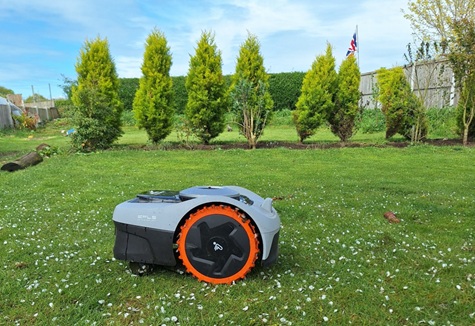
There has been a significant shift in the production of robotic mowers, robotic line-markers and other autonomous machinery in the last five years. We now have vast choice of products to suit needs and budgets.
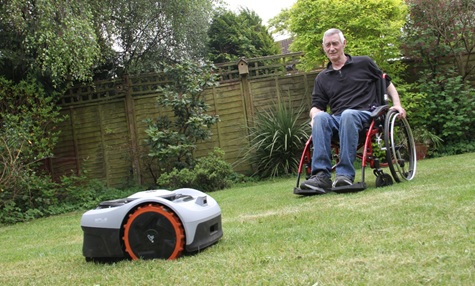
I manged to get my brother-in-law who is disabled to try one and he finds it a great help. It saves him time aver and prevents worrying about the lawn.
These robots have increased their sophistication with a whole range of on-board technologies to enhance their performance and reliability.
The biggest reason is simply automation. Robotic mowers can be scheduled to cut the lawn automatically and return to their charging station when finished. Once installed, they require little human involvement.
Robots are also being sold on the back of environmental benefits. Traditional petrol lawn mowers produce emissions and noise. Robotic mowers are usually battery powered, which means, no direct emissions while operating, much quieter operation and lower energy consumption.
We are also seeing much improved GPS and AI navigation, obstacle sensors, boundary detection and smarter mowing patterns - along with better cutting and traction modifications to enhance reliability and performance.
These improvements mean they can handle more complex lawns and operate safely around obstacles.
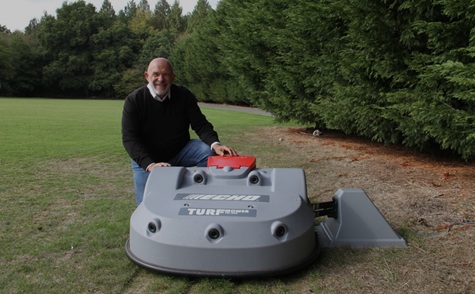
Gary Whitney who runs Smart Lawns specialises in the demonstrating and selling of robotic mowers, having spent most of his working life selling traditional mowers for STIGA and other manufactures. I recently went to see Gary for an article in Service Dealer magazine, to learn about which robotic mowers he advocated and what he thinks of these new advancement in autonomous mowers.
Most of the early robotic mowers were centred on the domestic markets, however we are now seeing. especially during the last five years, manufacturers developing products for the professional end users. Local authorities, estates, football clubs, housing estates and golf courses are all now embracing the use of robotic mowers and devices.
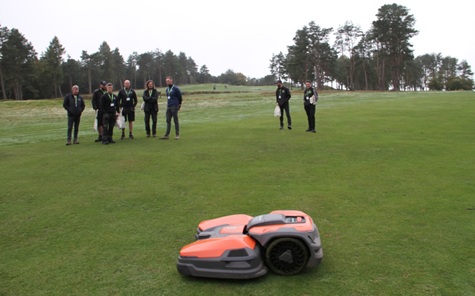
A lot of golf courses are now investing in robotic mowers to cut fairways, roughs and ranges. We also now have robotic golf ball collectors tidying up ranges.
Several professional football clubs use them to mow amenity areas thus reducing the workload of the turf professional to enable them to spend more time to work on the playing surfaces.
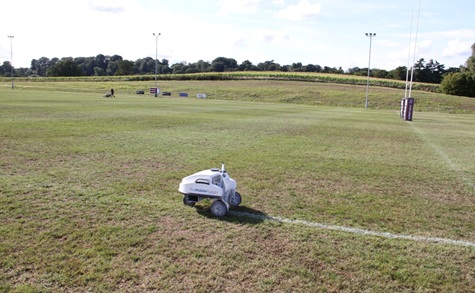
As for line making machines, they are becoming popular with many clubs and contractors who are investing in them for their accuracy and time saving capabilities. Both rugby and football pitches can be marked out in fewer than 20 minutes. A recent visit to my local club Newport RFC enabled me to catch up with Neil Furness who uses a Tiny Robot for marking his pitches.
Again, there are now several companies manufacturing robotic line markers giving you a range of products to choose from.
Also the costs of these robotic mowers are becoming competitive. For robotic mowers capable of 10,000–25,000 m², you’re firmly in the commercial / professional segment (sports pitches, estates, campuses). Pricing increases sharply because these machines use RTK GPS, fleet management, and heavy-duty drivetrains.
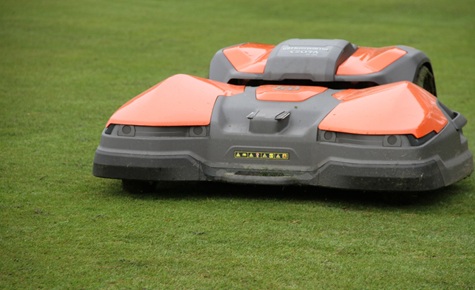
These robotic mowers depending on the needs of the end user, and type of product required, will dictate which robotic product is best for your needs. Most of the leading manufacturers (the likes of Husqvarna, Kress, Stiga, ECHO Robotics, Bel Robotics and others) will have a plethora of robots costing between £5000-£30,000 depending specification required.
In fact, STIGA are working with the RFU and offering a deal for clubs to have a robotic mower to cut their pitches.
For me personally, I have tried and tested several robotic mowers and without doubt they are a great tool that provide an alternative method of mowing grass. They are becoming much more robust and now offer greater performance and efficiencies.
They have their place in an ever-changing environment and I can see at the domestic and semi-pro level they will be a great acquisition. However, for many of the elite sporting venues it would seem that the current professional human-operated cylinder mowers are still the preferred choice for cutting their sports facilities.
Time will tell, but I am sure that before long we will see many more improvements to the growing army of robotic mowers.