Over the course of the next twelve months, I will be delving into many of my memories, and excursions undertaken, to highlight the management and maintenance our unique sports turf and amenity and landscape sectors.
Here is the next part of my look at golf stewardship through the decades.
In this installment I want to mention some of the fine people I have met and the golf courses I have visited during my role of editor over the last twenty plus years.
I need to start with one of the most rewarding interviews I conducted in 2005 when I was at Pitchcare.
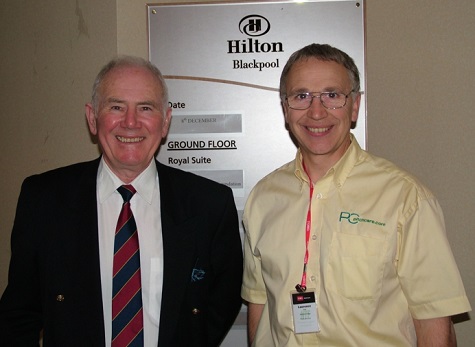
Me and Walter Woods
I was working at the BIGGA BTME show in Harrogate and I managed to persuade Walter Woods to do an interview. Walter, after a successful time working the at the Notts Golf Club (Hollinwell), became superintendent at the Home Of Golf, St Andrews, in 1974.
During his time as superintendent of the famous links, Walter oversaw four Open Championships. So respected was he, that Jack Nicklaus would turn up early at St Andrews to play practice rounds with him prior to the tournament.
Walter left St Andrews in 1995 after 21 years on the links but continued as a consultant to the European Tour.
Walter spent many years as an ambassador raising the profile of greenkeeping. It was a special moment for me spending time talking golf with such a greenkeeping legend of the industry. He was such a humble and genuine man. Unfortunately, Walter is no longer with us, he died in 2018, but I know his legacy lives on via the many greenkeepers who had the privilege to meet and learn from him over the years.
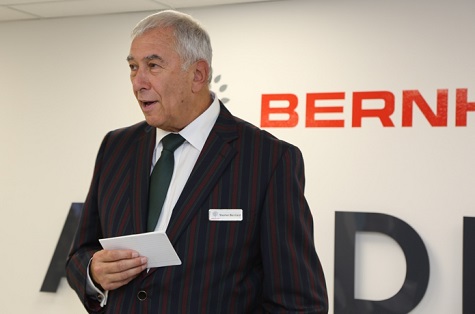
Stephen Bernhard
Another stalwart of the industry must be Stephen Bernhard. His contribution to the industry is on a scale that few could hope to match. As the founder of Bernhard and Company, his impact has been felt across the UK and far beyond. With an unwavering commitment to education and professional development, Stephen has provided countless opportunities for greenkeepers to achieve new heights, not least through his support of the BIGGA Delegation to the GCSAA Conference and Trade Show and the establishment of the Bernhard Academy in 2019.
Stephen has been surrounded by horticulture from a young age. Determined to follow in the footsteps of his father, who held a leading position within the industry in the UK, Stephen expanded the export division of Jeffery and Sons Ltd in 1972. He did so by first addressing the technical issues surrounding the mowing of turf and the critical effect that reel grinding techniques had on mower performance an overall quality of cut.
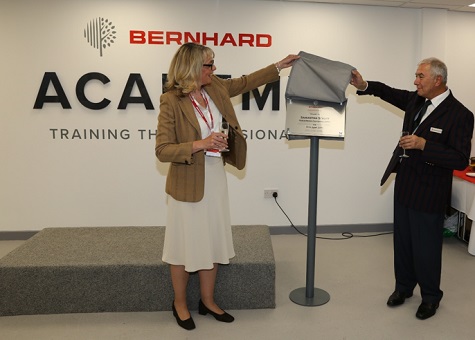
Stephen and Sammi officially opening the Bernhard Academy
His work led to the production of a range Bernhards grinders we now see at many golf clubs and the company providing tournament support at many UK and international golfing events and, in later years under the stewardship of Steve Nixon, the development of the Bernhard Academy which is now run by Sami Strutt.
I have plenty of memories of a trip to Ireland shared with Steve Nixon, when we were demonstrating a range of Grinder products to a number of golf courses. It truly was a trip to remember.
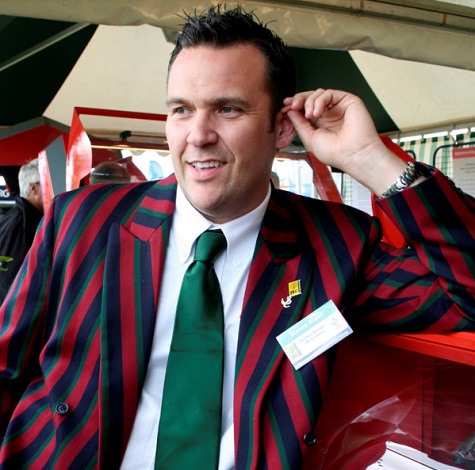
Steve Nixon in his favourite blazer
In 2008, I was fortunate to meet a group of greenkeepers from the Wales and Cheshire area who became infamous as the Gingerbread men and the 2 millimetre debate that took place at the Holiday Inn, Harrogate January 2010. For many, this still holds plenty of controversy regarding the management of greens playing surfaces today.
Over two hundred greenkeepers were crammed in to the conference suite at the Holiday Inn, all expecting a lively discussion between the assembled panel of speakers and the packed audience.
The panel was made up of some of the UK's leading greenkeepers, agronomists and golf architects, including Greg Evans, who was HG at Ealing Golf Club where he was maintaining greens at 2mm. This was the catalyst for the debate.
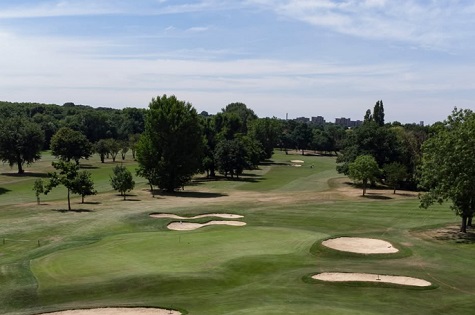
Ealing GC
Greg has since gone on to become a golf consultant delivering a full range of sports turf services ranging from complete golf course management packages, full course audits, project management, alterations, and reconstructions.
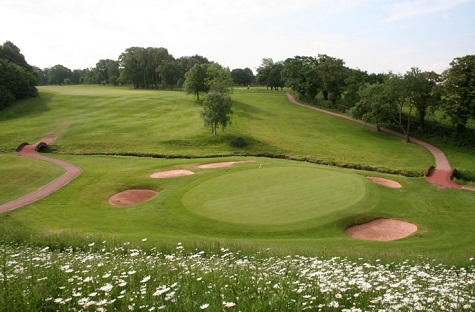
Wimslow GC
The debate centred on whether it was sustainable/ manageable to maintain greens at a height of 2mm, something that the group did not agree with. They were more aligned with the working practises of Jim Arthur, a golf agronomist who thought that many of the new practices happening both in America and Europe at the time, were so misguided as to be fundamentally wrong - because they so drastically altered the ecology of fine turf that the fine species became out competed by Poa annua.
Jim was an ecologist, understanding that if you wanted to encourage fine grasses you had to create the conditions that allowed them to be competitive. In his book ‘Practical Greenkeeping’, he summarised five basic rules of thought:-
- Aeration - “the most important operation on any course”
- Fertiliser treatment - “minimal and basically nitrogen only”
- Topdressing - “never chop and change”; “match the topdressing with the root zone”
- Mowing - “do not mow too closely to speed up playing surfaces”
- Irrigation - “the function of irrigation is to keep the grass alive”; “green is not great”
The five laws never alter in principle but do very much alter in detail. This being because there are so many differing details, not only environmental, but also in the aim. No two golf courses are identical, nor indeed are the demands of golf club members, nor the aims and ambitions of course managers trying to meet those demands.
The debate on how and what are the best ways of managing a golf course are still debated today. For me it’s having the ability to understand the basics of soil, plant and water relationships and how best to manage the environmental conditions you are presented with at your golfing facility. Using the resources, knowledge and budgets you have control off.
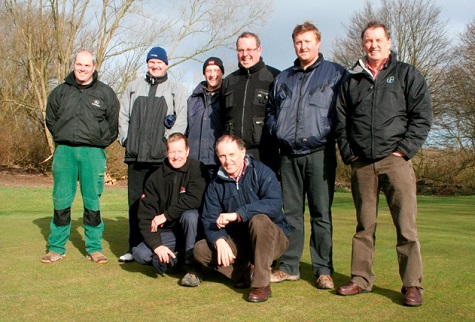
The Gingerbread Men
As for the group of Gingerbread men, many are still working in the industry
- Stuart Yarwood formerly HG at Lynn Golf Club is now working for DLF
- Paul Lowe formerly HG Bromborough GC is now working for Aquatrols
- Steve Outram formerly HG at Wimslow GC now working for the RHS
- Andy Ralphs, Delamere Forest GC, still there
- Andy Peel, Bull Bay GC Anglesey, retired
- Carl Croucher, HG Caldy GC, still there
- Roger and John Kerry from Royal St Davids Golf Club in Harlech, retired
- Brian Taylor, Sandiway Golf Club, retired
For me these are a great group of dedicated greenkeepers who, like many, have dedicated their lives to looking after a golf course environment.
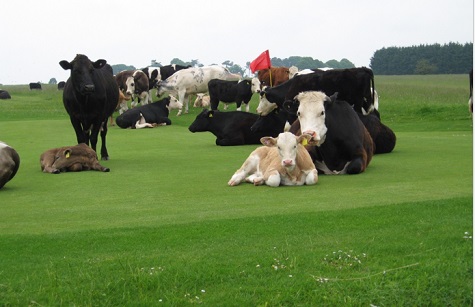
The cows on the golf green at Michinhampton Common
Moving on, some other interesting golf people I have met have been Paul Worster who was course manager at Minchinhampton Golf Club and chairman of BIGGA in 2010.
The club now comprises of three golf courses, each of quite different character. One of the courses is set on Minchinhampton Common, a Site of Special Scientific Interest and hosts herds of local cattle. Which brings its own unique set of challenges.
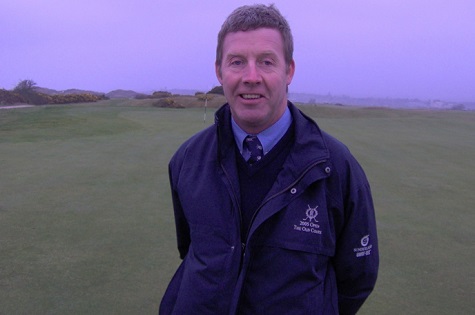
Gordon Moir at St Andrews
I also must mention Gordon Moir, who in 1991 joined the St Andrews Links Trust as head greenkeeper of the Eden Course. His expertise and leadership led to his promotion as director of greenkeeping, a position he held until his retirement in December 2018. During his tenure, he oversaw preparations for numerous prestigious tournaments, including three Open Championships, two Women's Opens, a Senior Open, a Curtis Cup, and several Dunhill Links Championships.
Gordon was instrumental in implementing sustainable practices at St Andrews Links and played a pivotal role in dune restoration projects on West Sands. His commitment to environmental stewardship and excellence in course management earned him widespread recognition. In 2023, the University of St Andrews honoured him with the University Medal for his outstanding contributions.
Beyond his responsibilities at St Andrews, Gordon served as vice president of BIGGA in 2020 and ascended to the presidency in 2021, reflecting his dedication to advancing the profession.
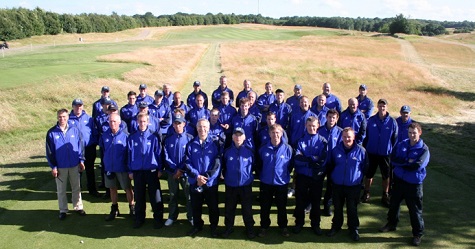
In 2008, again I was lucky to help by working with an invited team of greenkeepers to help prepare and maintain the course at The London Club for a European Open Tour Event.
It was certainly a great experience to be working with a great team of fifty plus volunteers drafted in to help Peter’s staff prepare and maintain the course during the event.
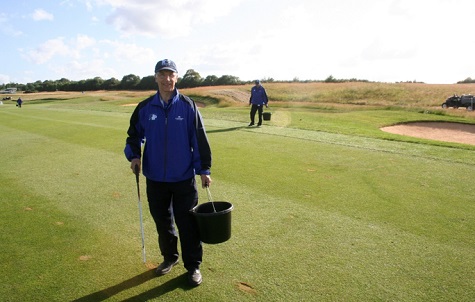
I spent a couple of days divoting fairways and raking bunkers. It was a great experience for me and many of the others that volunteered to work.
It is amazing to see the sheer volume of work that gets done pre and post play. Essentially the whole course is fully repaired, mown before and after play. You virtually carry out all the jobs you would normally do in a week or more. Attention to detail is the key narrative.
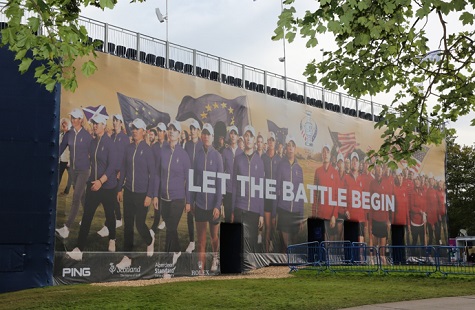
Another memorable occasion was in 2019 when I, along with other members of the trade press, were invited by John Deere to attend the Women’s Solheim Cup at Gleneagles GC.
We all had an amazing experience seeing the sheer scale and size of this event. John Deere was the Official Golf Course and Turf Maintenance Machinery Event Partner at Gleneagles for the 16th edition of the biennial match.
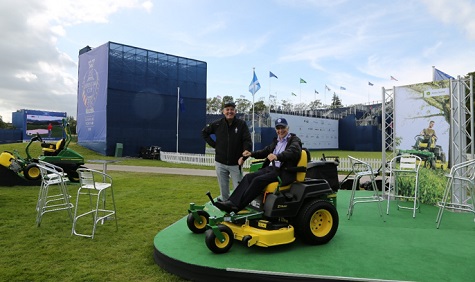
Me and Chris Meacock on the John Deere stand
Talking about John Deere, I also had the opportunity to travel to their World Headquarters, located in Moline, Illinois, where John Deere relocated his growing business empire.
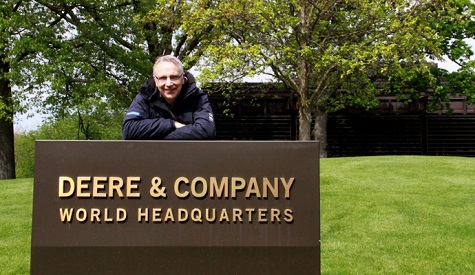
Again, a marvelous trip and we were able to see the vast investment into agriculture and grounds equipment John Deere are making.
Another key person who has dedicated his life to the game of golf is Jim Mackenzie MBE. A highly respected figure in the golf industry, Jim serves as the director of golf courses and estates management at The Celtic Manor Resort in Newport, Wales.
With a career spanning over 40 years, Jim has been instrumental in elevating Celtic Manor to international prominence, particularly through his pivotal role during the 2010 Ryder Cup.
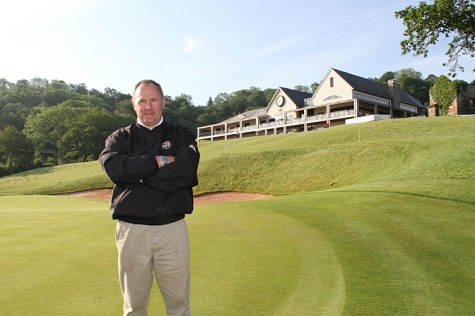
Jim Mackenzie MBE at Celtic Manor Resort
Joining Celtic Manor in the 1990s, McKenzie oversaw the development and maintenance of the resort's golf courses. His expertise was crucial during the 2010 Ryder Cup, where he led a team of 110 greenkeepers, support staff, and volunteers. Despite challenging weather conditions that caused significant delays, Jim's leadership ensured the course remained playable, allowing the event to conclude with a win for European team. I was again fortunate to spend a day covering the work being achieved at a senior’s event.
Other key industry course mangers that I have met are Kenny Mackay, director of golf courses and grounds at Wentworth GC; David Cole MG, director of agronomy at A&M Fife, who previously spent many years at Loch Lomond GC.
Away from the gloss of prestigious golfing venues, next time I will reflect on some of the grass roots golf clubs that are competing with the large corporate golf businesses.
You can also read:
Part one of 50 Years of Golf Stewardship here
Part two of 50 Years of Golf Stewardship here
Part one of Cricket Through The Decades here.
Part two of Cricket Through The Decades here
Part one of my 50 years of football here
And part two of 50 years of football here.

