I recently read Mark Hunt's weather blog - always a good catch up on what’s happening with the weather fronts in the UK.
Mark said “January 2026 will go down alongside December and November 2025 as a truly dull and dreary month with very high amounts of rainfall. In particular the south coast, southwest of England, Wales and The North West have been in the firing line. Further north there has been a significant amount of winter snow. The only positive I can draw on is that at least we have recovered a significant % of depleted water reserves from last year’s drought.”
The UK experienced well above-average rainfall in January, with parts of the UK recording exceptionally high totals. Northern Ireland saw about 195.6 mm - around 70 % above its long-term average. While the UK as a whole had significantly higher than normal rainfall, with southern England among the wetter areas.
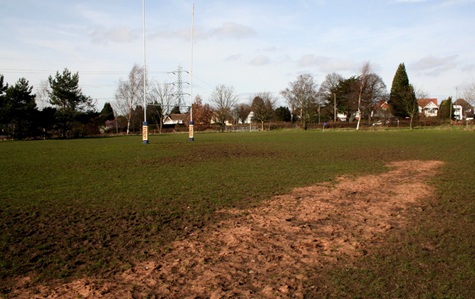
This spell of prolonged wet weather has not only caused local flooding in some parts of the country, but has over time caused saturated ground conditions on many grass roots sports facilities, often rendering them unplayable.
Managing saturated sports fields is about protecting turf health, maintaining playability, and preventing long-term soil damage. Best practice combines immediate controls, short-term remediation, and long-term drainage/soil strategies.
It often beggar’s belief that we are still seeing poor groundsmanship practices being carried out during inclement weather conditions. It often comes from people not understanding the consequences of their actions.
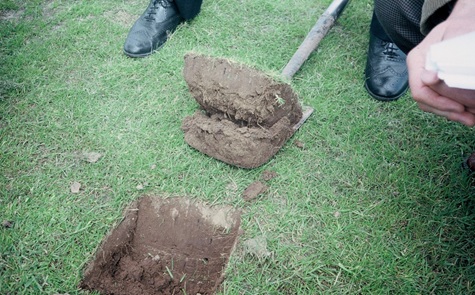
Many of these postponements could be prevented if clubs were to invest more into their pitches, both during the construction phase and post construction, and having a robust maintenance regime in place.
However, for many natural soil-based pitches it is more about the lack of maintenance and understanding about the type of pitches being managed. Understanding your soils, and how to manage them, will go a long way to producing a decent playing surface.
Understanding soils and an understanding of the soil’s physical properties has always been important for professional turf managers when making decisions about maintenance operations and when carrying out reconstruction works.
Soils can vary in many ways, both physically and chemically, on a local or regional scale. This soil variability gives rise to all the different types, universally classified by soil texture composition. Soil composition (soil texture) is determined predominantly by mineral particles and organic matter content and can be classified by the percentage of sand, silt and clay mineral particle content. The Soil Texture Triangle, as shown on the image above, helps us classify the soil type, these percentages are determined by undertaking a PSD, particle size distribution analysis.
The definition of soil texture is the relative proportion of sand, silt or clay in a soil. Most soils contain a mixture of different soil particles. The particles and the soil's structure determine the pore spaces. A soil with a high proportion of coarse sand will contain large pore spaces and drain quickly, whereas a soil having finer sand, silt or clay particles will contain smaller pore spaces, and therefore will drain more slowly.
The strength and permeability of any soil is determined by its structure, soil type, drainage capacity and how well it is managed. Soils will perform differently, governed by the amount of water, root mass and air there is in the soil matrix. Most pitch problems are caused when soils are saturated and compacted. When saturated, a soil is said to be at its maximum retentive capacity; that is, all soil pores are filled with water.
Saturation usually occurs for short periods of time, either during heavy rainfall events or when soil is being irrigated. Firstly, we need to understand what problems are facing turf professionals when pitches become flooded and remain saturated for long periods of time.
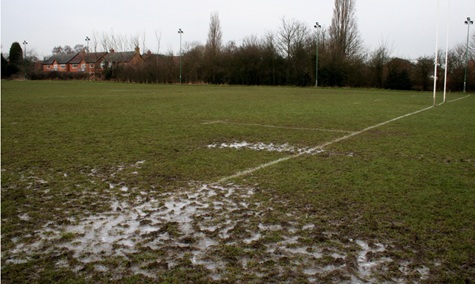
Once a pitch becomes saturated, that is to say all the pore (air) spaces in the soil profile remain filled with water, then we are in a situation of the pitch being in a poor state and will be prone to damage.
However, the main contributing factor that reduces and damages pore spaces in soil is compaction - caused by compression forces, normally associated with play and use of machinery, particularly during wet weather periods.
Over time, these compression forces reduce the pore spaces so that air, water and nutrient flow through the soil profile is restricted, leading to many problems associated with compaction. The heavier the soil the longer it will take for the pitch to dry out; sandy soils are more free draining than heavy loam or clay soils and, therefore, will dry out more quickly.
Drainage
Having an effective pitch drainage scheme will help. Most modern pitches tend to have primary and secondary drainage systems installed. These systems aid the removal of surface water quickly and tend to keep the pitches playable in periods of wet weather.
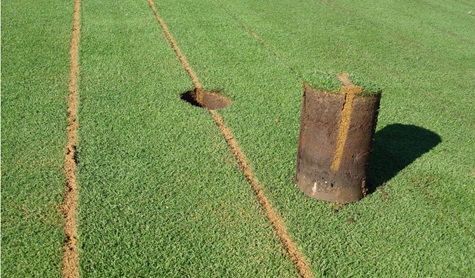
However, the effectiveness of any drainage system can be compromised over time when the drain runs become capped; it is important to retain a link between the drains and the playing surface. This will be achieved by regular aeration work and the application of topdressings.
Ideally, clubs should be putting on at least 40-60 tonnes of sand per pitch each year. This not only keeps the playing surface free draining, but also helps to restore levels.
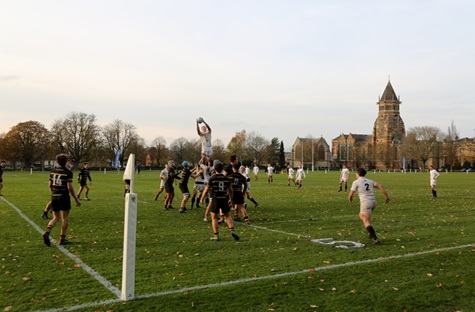
Playing on saturated pitches will bring disastrous results. It is often better to postpone a fixture rather than ruin the playing surface for the rest of the season. Scrummage and line out play are the main causes of damage on rugby pitches during wet weather periods.
The severity of the damage will be dependent upon the soil type and the ability of the top 100mm to drain quickly. It is important that, once the game has finished, remedial work is carried out to repair divots and stand the grass back up.
Care should be taken not to further damage the pitch by trying to get machinery on when it is wet and saturated. Brain Sandals in his Turfcare Blog has recently produced an article that gives good advice on Maintaining winter pitches.
Aeration should be carried out on a regular basis when weather and soil conditions allow. You may contribute to surface deterioration if you aerate during bad weather when the surface is saturated and likely to smear; timing is the key to successful aeration.
There is a wide range of professional aerators for use on winter turf pitches, available as walk-behind, ride-on, trailed or tractor mounted. To alleviate these compacted layers, we need to consider a range of different techniques and equipment that can encompass the different types of playing surfaces. The main aim of aeration is to penetrate the soil profile to create new macro pore space.
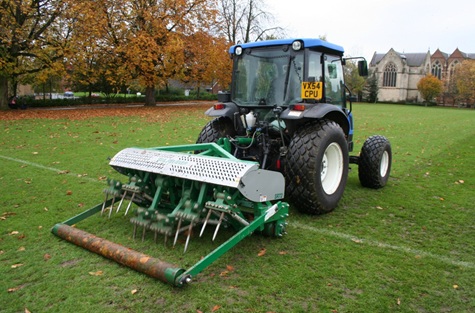
This is achieved by several methods:
- Solid tine – Verti drain type vertical punch aerators
- Hollow/coring tines that remove soil cores from the soil
- Trailed outfield Multi tine spikers (knife / solid tines)
- Disc/blade implements (linear aerators / Soil recyclers.
- Compressed air aerator systems
It is essential to use a variety of aeration techniques to prevent pan layers being created.
This usually happens if you continue to use the same aeration technique set at the same depth, resulting in a compacted layer forming at the base of the tine or core depth. Most turfgrass managers will, therefore, vary the methods of aeration by changing the depths, size and diameter of tines.
To help grass roots sports clubs with potential funding to improve their facilities or buy essential machinery the GMA launched The Pitch Advisory Service, formerly the Grounds and Natural Turf Improvement Programme, that was originally launched in 2014 and is funded by Sport England and the Football Foundation, working in association with the ECB, RFL and RFU.
The aim of the Pitch Advisory Service is to raise the standards of sports surfaces as well as the understanding of sports turf management practices among grassroots sports clubs across England.
Some tips and maintenance regimes to help restore and prevent damage to saturated sports pitches
- Immediate / In-Season Management to prevent compaction and surface damage will include postponing matches/ fixtures when standing water is present.
- Refrain from trying anything to get the match on, keep off your pitches until the surface water has drained away.
- Rotate activities to less-used areas (sidelines, warm-up zones). Use portable goals and movable training grids. Rope off chronically wet areas. There are several aids to remove surface water, Squeegees, pumps, or slit drains to move water off the surface.
- Short-Term Agronomic Actions to aid recovery will be centred on aeration work to help drain water away, relieve compaction and restore oxygen to the rootzone.
- Sand topdressing, Light, frequent applications will help to dilute organic matter and improve surface porosity.
Maintain a healthy sward, the grass plant is one of the most efficient water pumps, keep on top of weed growth and regular overseed to maintain a dense sward.
- Medium–Long Term actions are centred around improved surfaceand sub surface drainage techniques, regular deep aeration with either a linear or solid tine spiker.
- Reduce thatch and organic matter via controlled hollow-tining and application of sand dressings.
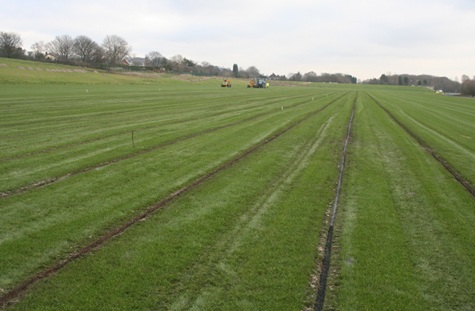
- Install lateral drains (pipe and gravel) tied into an outlet. Slit drains can be effective where full reconstruction isn’t feasible.
Let’s all hope we get some better weather soon, longer daylight hours, some Easterly winds and some late winter sunshine to dry up these saturated pitches.