Last week I attended an Integrated Weed Management Conference in Birmingham, hosted by Kersten UK, a UK company specialising in the development of machinery products to help control and maintain weed free hard surfaces.
In 2004, Kersten UK began importing the Kersten range of sweepers and grounds maintenance equipment from Germany. The business is a family affair led by Chris Faulkner, together with his two sons, Sean and Douglas, and supported by a team of 15 based in Reading.
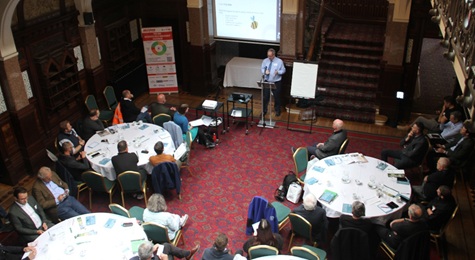
Kersten UK have over many years, been developing new strategies for managing weeds using a mix of tools and techniques. Instead of depending on a single control method such as pesticides, they can integrate different preventative and control methods to control weeds in different site-specific sites.
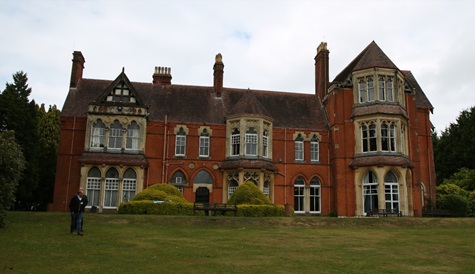
Highbury Hall
The day centred on a series of presentations and the opportunity to see several demonstrations of integrated weed management practices that have been developed to eradicate weeds instead of using pesticides.
.
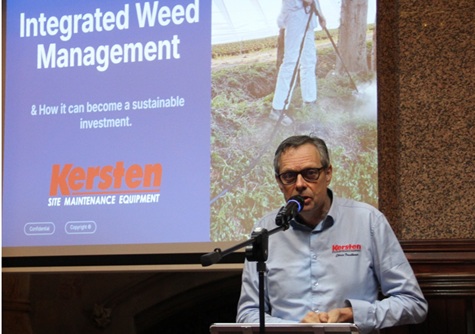
Chris Falkner, Kersten UK
Chris Falkner began the conference with a warm welcome to the 70 plus delegates in attendance that was made up of parks professionals, contractors, company and sales reps.
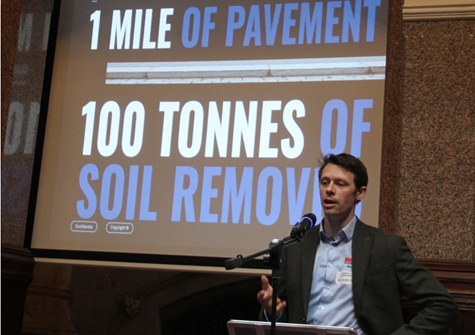
Sean Falkner, Kersten UK
The first presentation was, given by Sean Falkner who spoke about the number of different, integrated approaches we can now use to control weeds in the environment. He gave us an example of a case study he came across where a council was dealing with the issue of removing tonnes of detritus (soil) that had built up on their roads on paths over time many years, that effectively provided the ideal environment for weeds to grow in.
The shear amount was because for well over 20 years the council had allowed the encroachment of detritus, mainly due to the lack of regular maintenance regimes and in particular the lack of sweeping to remove it.
A similar picture of this problem is also seen, across many local authorities up and down the country. It is estimated that for every mile of pathway, there could be about 100 tonnes of soil / detritus now needed to be removed. In most cases councils would regularly spray the weeds to control growth, but this was not really solving the problem but prolonging it.
The key to keeping roads and pathways clear of weed growth is by regular sweeping regimes and, over time, by keeping the build-up of detritus to a minimum. This both prevents weed growth and keeps the paths and roads clean, which in turn prevents road drains from blocking.
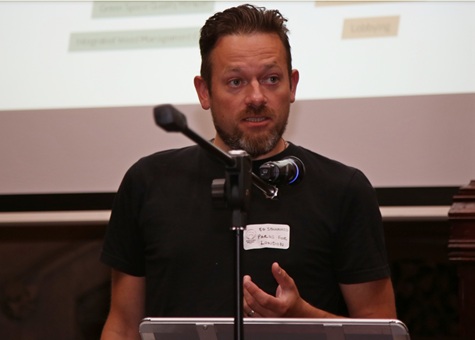
Ed Stannard
The next speaker was Ed Stannard - executive director of the Parks for London – a charity working across London, that supports landowners and managers to network, collaborate, share and develop good practices and maximise resources by running networks, holding events, developing guidance, lobbying, advocacy, benchmarking and wider sector development in key areas such as fundraising and skills.
Ed was keen to elaborate on the scale of the organisations / council / landowners they support. It is a complex mix of 32 boroughs and the City of London. They also support major charities like the world of parks and the London Wildlife Trust, independent Park trusts like Gainsbury Park, Crystal Palace and Shirley cows and gardens and development corporations like the LDC, who run the Olympic Park, managers of public sector estates, housing associations, NHS, foundation trusts, commons, conservators, universities and many more.
Ed was here to launch the new Integrated Weed Management reference guide. The Guide provides key information and useful resources in designing and tailoring integrated weed management plans with regards to your local sites. The Guide covers all urban green spaces, including specific landscape uses such as parks, rail, or highways.
This reference guide was developed by the Parks for London, and the Amenity Forum with support from Kersten UK and Defra. Read more about it, here.
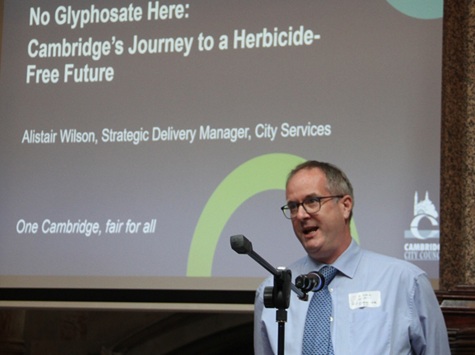
Alistair Wilson
The next speaker was Alistair Wilson - Cambridge City Council who gave an account of how his council chose to go down the road of not using pesticides to maintain weed growth in the city. A new Herbicide Free Weed Management Work Programme has now been approved by the council which will allow a for a systematic ward by ward approach to managing the growth of unwanted vegetation across the city.
This new work programme follows the decision to discontinue the use of herbicides across all council owned sites, including parks, car parks and housing areas in March 2024.
Instead of herbicides, mechanical sweepers and hand tools, such as hoes and brushes will be used. These tools are better for the environment, and better for the health of residents and council officers than standard herbicides. The concept began back in 2019 and now after a few years of planning and programming new working practices the council now operates a total free non use of pesticides to maintain weed growth in the city.
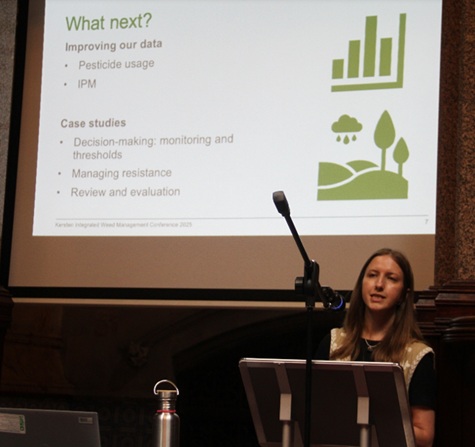
Catriona McCallion from Defra
It was then the turn of Catriona McCallion from DEFRA to discuss the implications of the new National Action Plan for Amenity.
This March, the Government published the UK Pesticides National Action Plan (NAP), setting out a future of more sustainable pesticide use, which protects the environment and human health. Catriona spoke about the aims and objectives of the plan and gave an insight into its focus on best practises when using pesticides.
The aim of the NAP is to encourage a 10% reduction in the use of pesticides by 2030 and ensure people are carrying out effective IPM strategies.
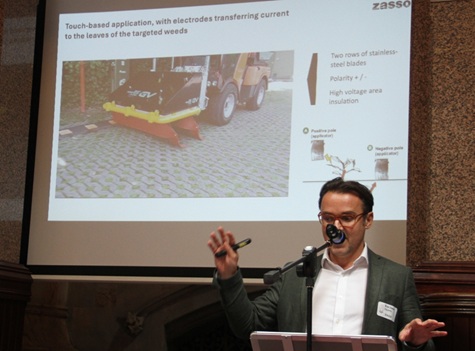
Benjamin Ergas
Following Catriona was Benjamin Ergas, CEO of the @Zasso group AG, who as a company have developed several machines to control weeds using an electrical current to kill the plants. He was keen for us to see the machines in action during the afternoon’s demonstrations.
He was also keen to explain how their machines worked, how safe they are and the type of landscape situations where they can be used.
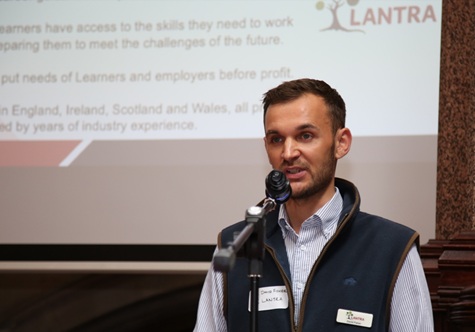
David Fisher, Lantra
Next up was David Fisher from Lantra who spoke about the role of Lantra and the launch of a new qualification in Integrated Weed Management.
As the future of pesticide use becomes a key issue, these new courses will explore a combination of non-chemical and chemical alternatives, providing attendees with a nationally recognised certificate. Material covered includes the principles behind managing vegetation, the advantages and risks of various control methods, and the changes in weed control policy and practice so to create tailored integrated management plans to specific landscapes to efficiently protect public spaces.
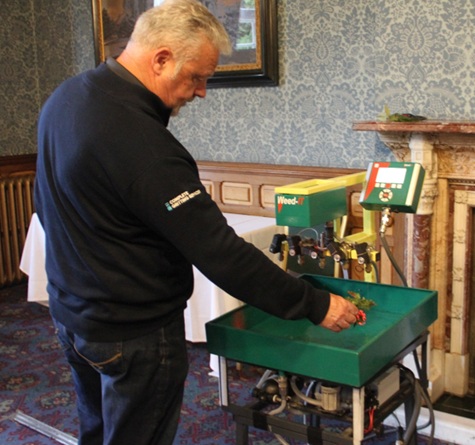
Mark Pryah, sales director, Complete Weed Control, demonstrating the Weed-IT sprayer technology
We then had lunch, which gave me a chance to catch up with some of the delegates attending the conference. These included Mike Hinton, parks manager for Birmingham City council, Nick Darking from BAGMA, Mark Pryer, Complete Weed control and Professor John Moverley to name a few.
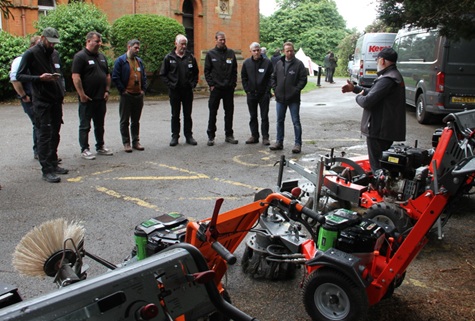
Selection of sweepers
As for the afternoon sessions, it was all about giving the delegates the opportunity to see a number of the new methods of treating weeds using non-chemical techniques such as thermal or electrical methods.
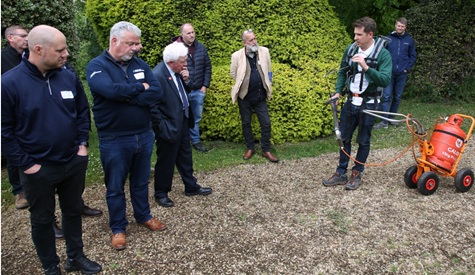
Thermal burner
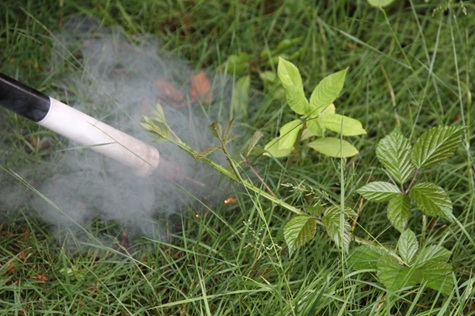
Electric probe
On show was a gas burner lance that effectively scorches the weeds. An electric probe that delivers high voltage charges that effectively destroys the living part of the weed via its leaf, stem and not the roots. Hot water that again destroys leaf tissue. Also on show was a range of brush and sweeping machines used to sweep roads and paths to remove detritus and surface debris.
The final part of the day centred on a panel discussion about the future of Integrated weed management that featured four additional speakers - Professor John Moverley OBE; Nick Mole, pesticide action Network; Bradley Tennant, International Greenkeepers for Hire; and Sean Falkner, Kersten UK.
For me personally, I thought it was a highly informative day with plenty of interesting content and a chance to see at first hand some of these new non-chemical technologies, that are now becoming available.
While some of the non-chemical treatments, are still more costly than applying an herbicide, it is really a case of understanding what are the best methods of weed control for a given situation. For me, the new guide on Integrated Weed Management will be an immense help in assessing the best way to tackle a specific weed problem. The key is to take into account the resources, budgets and environmental factors facing you to control a given weed species. As pointed out, most weeds seen in roads and pathways are down to the build-up of detritus. If you regularly clean and sweep these areas, there will be no detritus or soil for the weeds to grow in.
I thoroughly enjoyed the day and would like to thank Chris and Sean for inviting me to their conference. I’m sure it will not be long before we have a chance to attend another one.