Over the course of the next twelve months, I will be delving into many of my memories, and excursions undertaken, to highlight the management and maintenance our unique sports turf and amenity and landscape sectors.
You can read part one of my 50 years of football here.
Part Two
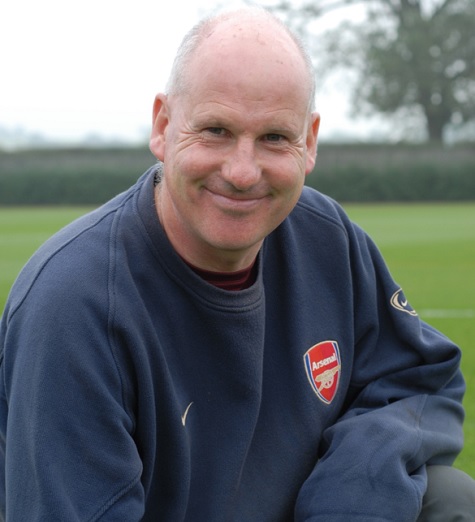
Steve Braddock, Arsenal
During my time working in the industry there have been a number of specifically focused turf professionals who have taken the industry forward. Steve Braddock at Arsenal was one of the many pioneers who changed the way we go about maintaining football playing surfaces.
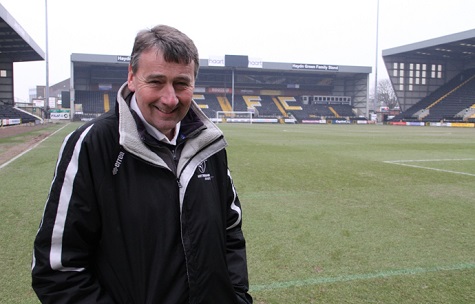
Greg Smith, Notts County, now at Nottingham University
I’d also include in that category the likes of Roy Rigby at Manchester City, Keith Kent and Keith Porter who worked at Manchester United, along with their current HG Tony Sinclair. Also important are Richard Norton, Bolton FC; Chris Hague, Steve Tingley, Karl Standley, Wembley HG; Steve Patrick, Blackburn FC; Greg Smith, Notts County FC; Jonathan Calderwood, Paris Saint-Germain; and Michael Finch, Coventry FC.
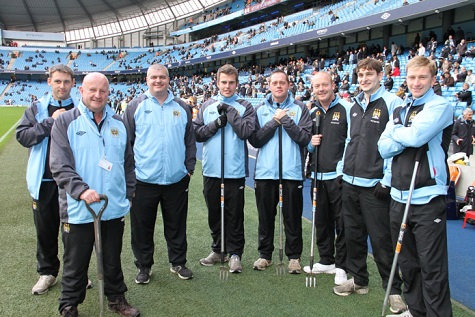
Roy Rigby and his staff at Manchester City
Andy Croft, Stoke City, and David Roberts, Liverpool FC, are a couple of many who have set the standards for many of the current batch of leading lights in charge of national and club stadium pitches and training grounds.
John Ledwidge is another, now the head of grounds and landscapes at Manchester City Football Club. He recently took over from Roy Rigby and had previously overseen the transformation of Leicester City’s facilities, creating one of the best turf academies in the country.
Whilst most attention was focussed on the development and maintenance of stadium pitches, it was the unseen work being done on a daily basis at the club’s training grounds that should be recognised. This relentless work goes on 365 days of the year and, with on average more than 15 pitches to maintain, it is often a huge undertaking.
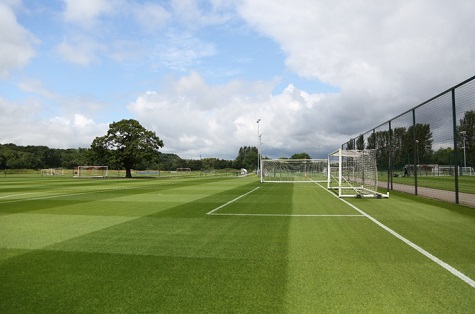
Stoke City's training ground
In recent years, particularly since the millennium, we have seen a huge investment at the training grounds, with many clubs ditching soil-based pitches and mirroring their stadium pitch constructions, meaning the players are training and playing on similar playing surfaces.
Manchester City, Tottenham and Leicester City, now have exceptional training facilities with clubs boasting an array of pitch facilities both natural and artificial. John Ledwidge when at Leicester FC, undertook one of the most challenging jobs in overseeing the development of their new training ground at Seagrave, completed in 2020.
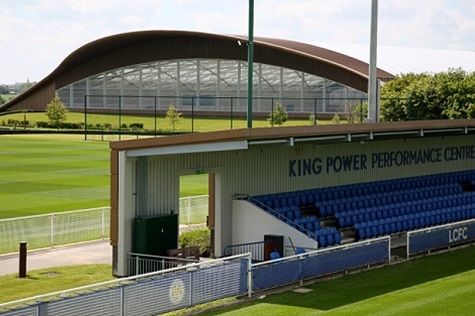
LCFC training ground
Under construction since Spring 2019, the new LCFC training ground was a huge redevelopment project on a massive 185-acre site, formerly a golf course. The facilities include 21 playing surfaces – including 14 full-size pitches; 499-seater floodlit main pitch; private nine-hole golf course and elite sports science and medical facilities including cryotherapy chambers, bespoke gymnasium and hydrotherapy facilities. It also includes the impressive Sports Turf Academy for the education and development of industry-leading grounds staff.
Having seen for myself this facility, it shows the investment clubs are prepared to commit to attract the best players and give them the most up-to-date training and welfare facilities.
Over the years I have met so many dedicated grounds practitioners who have all been a credit to this ever-evolving, challenging sports turf Industry.
What I find remarkable is the ongoing support and comradeship that fellow turf professionals have for one another.
Listed below are some of my fondest memories whilst traveling around the country. I have been fortunate to have attended some match day games, one of the first was at The Reebok Stadium home of Bolton Wanderers FC in 2008.
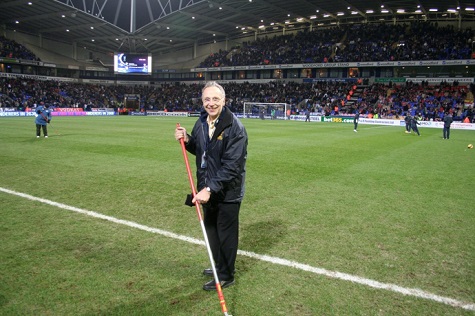
Me divoting the pitch
Richard Norton was head groundsman and had been at the club some sixteen years and had invited me to be part of the match day team for an evening UEFA Cup match against Athletico Madrid.
I witnessed the thorough preparations that go into a match and helped out divoting the pitch at half and full time. A long 16-hour day for the match day team.
Another enjoyable match day game was down at the Liberty Stadium, Swansea, where I met up with Dan Duffy the HG for their final game of the season. I arrived on the Friday afternoon as Dan was a stickler for match preparations.
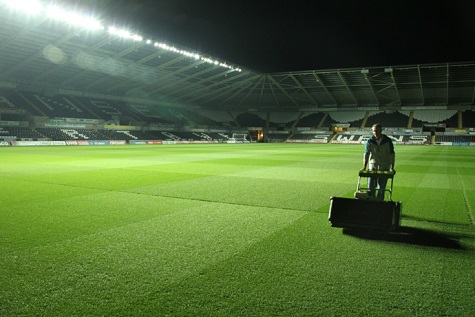
Dan Duffy mowing the pitch late at night
Dan's working hours are legendary at the club. The hours he does is staggering. Eighteen-hour days can be the norm when preparing and repairing the pitch for matches. So much so, that he has become quite nocturnal, often starting in the wee small hours of the morning.
Which was the case during my visit. Dan’s match day prep includes mowing the pitch three ways, the first cut was completed by 6pm. After a quick bite to eat we made our way back to Dan's office for a bit of a guitar session and a few more beers. This was to be my room for the night, while Dan got his head down in another office. We eventually retired around midnight to get some much-needed rest, before our early start, set for 3.00am!
I was awoken by Dan coming into the office and, within ten minutes, we were both out on the pitch. This was quite an eerie experience as the pitch was lit up by one set of floodlights to allow us to see what we were doing.
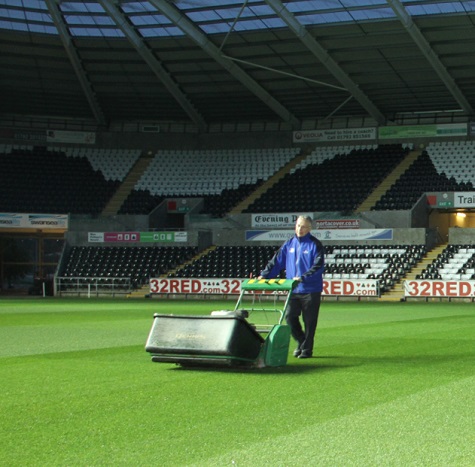
Me mowing the Liberty Stadium at 3am
Dan asked if I would be keen to help mow the pitch and, not wanting to let Dan down (but feeling rather rusty), I agreed to have a go. Dan set up the stripes and I followed. The first few runs were quite testing - the nap on the sward was quite fierce, tugging at the mower - it was a case of putting enough pressure on the mower to keep it straight.
I did offer to stop mowing if Dan thought I was below his standards, but he was happy to let me continue. I felt very proud to be mowing his pitch. It was certainly a first for me - not many people can say they have mown a football pitch at 3.00am in the morning!
We finished mowing around 5.30 and by then Dan’s staff were back to complete the final cut, finishing at about 10am, giving them a couple hours for final preparations for a 12.45 kick off.
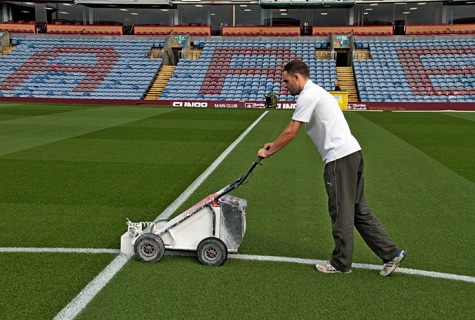
Barry O'Brien HG at Burnley marking out
My other two match day experiences were with Burnley and Manchester City. Both great days again, where I got to help and feel part of the team.
It goes without saying the dedication and long hours these turf professionals put in is off the scale. I would personally like to mention that I think it is about time Premiership and Championship clubs started paying a decent wage to these dedicated staff members and treated them with the respect they deserve for the skills and work ethic they achieve in delivering these exceptional playing surfaces.
For far too many years we have been poorly paid for the exceptionally long unsociable hours of work that go into producing a playing surface that sees today’s professional footballers earning well over £200,000 a week in many cases. The likes of players at Manchester City, United, and Liverpool in fact, are being paid in excess of £300,000 a week!
To put that into context next to a groundsman earning £30,000 a year - a week’s salary for one Premiership player would be enough pay a turfie’s wages for ten years. Or if you counted the full total of the squad of 25 players being paid the same wage we are looking at a weekly wage of £7,500,000 and obscene amount of money be paid?
Many of our Premiership grounds staff, with the exception perhaps of the HG, will only be earning between £18,000-£ 28,000. I believe it is time that grounds professionals are treated with due respect and paid a fair and appropriate wage for the highly skilled role they undertake to provide these elite facilities.
It is time football clubs finally recognised the professionalism of practicing groundsmen and women and the complexities involved in producing these top-class facilities. They should be setting a new wage scale for these highly-qualified professionals.
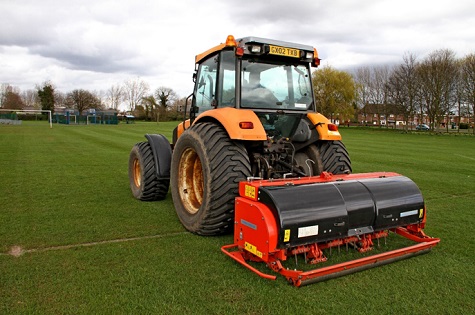
I cannot finish this article without a mention of the hundreds, if not thousands, of practicing grounds practitioners and volunteers who work in the lower leagues and tiers of the football pyramid.
Again, their passion and dedication to the sport is amazing, often against all the odds when they will be restricted with the resources they have at hand. Effectively they find a way to deliver decent playing surfaces for the sport to enjoyed by the thousands of players who turn up every week to play our national sport.

