Over the course of the next twelve months, I will be delving into many of my memories, and excursions undertaken, to highlight the management and maintenance our unique sports turf and amenity and landscape sectors.
Here is the first of three parts look at golf stewardship through the decades.
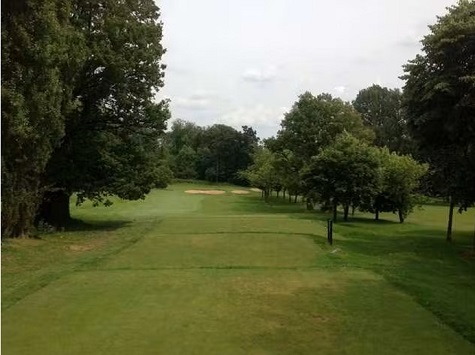
Cocks Moors Woods GC
My introduction to golf began in 1976 when I was working for Birmingham City Council as a greenkeeper on Cocks Moors Woods Golf Club.
Cocks Moors Woods is an 18-hole, par 72 municipal course located within the south of Birmingham. Set across 130 acres of parkland, the course features wide fairways, mature trees, and challenging greens.
The course was designed by the renowned golf course architect Harry Colt. Colt was one of the most influential golf course designers of the early 20th century and is known for his work on many famous courses around the world.
Still today many of the greens at Cocks Moors Woods are still clay pushed up greens. I have many fond memories of my time there and enjoyed the challenge of prepping the course for play. Like many 18-hole golf courses, back then maintenance of golf courses was centred around mowing tees, fairways, rough and greens.
As for staff and machinery, like most clubs we had very few resources. We had five staff. Andy Harris was the HG and the rest of us, John, Tiger, Eddie, Arthur and I made up the rest of the team.
As for machinery what we had back then was minimal. It comprised of a Ford Major tractor and trailer, two sets of cylinder gang mowers, one for the rough (3 units) and one for the fairways (five units). We also had two ATCO (24 inch) pedestrian cylinder mowers for banks and approaches / collars, two Ransomes Auto Certees (20 inch) for greens, a Pattinson spiker, and turf sod cutter for winter repairs. The rest was hand tools.
We would mow the greens three times a week, tees twice a week and banks, approaches and collars once a week. As for cutting the fairways it was a case of Arthur mowing constantly throughout the week to cut both the rough and fairways. He got very good at it having done it for the best part of 29 years.
The rest of the week we spent raking bunkers, clearing up debris, changing holes once a week and doing odd jobs to fit in between the regular maintenance works.
There was no automated watering system back then, with any watering was done by hand during the summer months. We had a brook running through the course and we pumped water via an old diesel driven pump engine. In fact, the year I started, I spent most of the summer of 1976 moving hoses and watering greens to keep them alive.
The winter months were centred around course repairs, woodland work, clearing ditches and raking leaves all by hand. One of the most dangerous jobs at the time was spiking the greens with the Patterson spiker - a mean machine, especially when working on slopes.
I do remember we did acquire a three-wheeled, Wrigley motorised truck that we utilised for transporting materials about. For most of the time we walked everywhere. I was probably the fittest I have ever been during my working career.
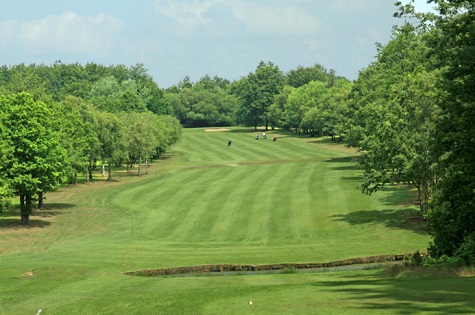
Waterlooville GC
Looking back at my time there, I have many fond memories. Later in my career I did find myself working at another golf course has an assistant HG at Waterlooville Golf Course in Hampshire in 1984. Times had changed and this course was better equipped, and the HG was a chap called Laurence Carlos, an interesting character.
It is staggering to relate what machinery we have today on a typical 18-hole golf course, compared to what we had back in the 1970s. There’s really no comparison.
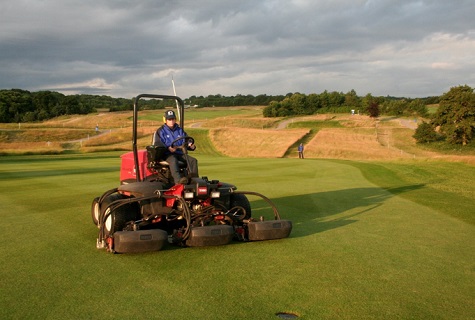
What have also changed are the expectations of the golfer; the popularity of the sport; its international TV coverage and above all the innovation of new products and services to help manage and maintain the courses.
Most 18-hole golf clubs, now have a plethora of mowers in their shed, ranging from pedestrian greens mowers to ride on triples, fairway and rough mowers. On top of that there will be a shed load of other complimentary machines and equipment to aid the greenkeeper to do their job of keeping the course presented, open and playable.
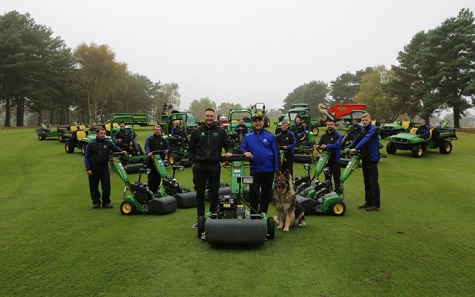
Andy Woods CM at Enville with his fleet of John Deere machinery
In 2019 I was invited to Enville Golf Club, near Stourbridge, West Midlands to the unveiling of a machinery deal that course manager, Andy Woods, had negotiated for the club to ensure they had the most up to date set of machinery to deliver the expectations of their members and raise the standards of golf at the club. All in all there were twenty five plus new machines delivered.
A significant investment that many clubs often need to make every five to seven years to ensure they have the right machinery to be efficient and deliver the standards of golf expected.
The total value of machinery for a modern 18-hole golf course typically ranges between £500,000 and £1.5 million, depending on course size, maintenance standards, and whether equipment is owned or leased.
The skill set of today’s greenkeepers is staggering. Many are qualified to a high level thanks to the constant support they get from their governing bodies and organisations such as The R&A, BIGGA, FEGGA, GMA, STRI, Lantra, GEO Foundation (Sustainable Golf), and other supportive organisations.
The workload at a typical 18-hole golf course in the UK varies depending on the season, weather, type of course (municipal, private, championship), and available staff. However, here’s a general breakdown of the daily, weekly, and seasonal tasks for greenkeepers.
Daily jobs centre around course preparations that include mowing of tees, greens, fairways, aprons, fringing rough, rough, semi rough, bunkers, hole changing, irrigation management, and maintenance of machinery.
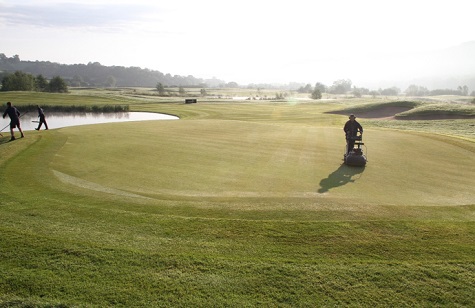
Other season work will be various additional renovation works, that include, aeration, scarification/ Verticutting, top dressing, brushing, fertilising, applying fungicides, pesticides and wetting agents. Then there will be tree works, clearing ditches, planting hedge maintenance and many other clearing up tasks.
Then there is also the plethora of winter projects that get done during the winter months October-March such as drainage works, path reinstatement, tree works, bunker refurbishments, planting projects to name a few.
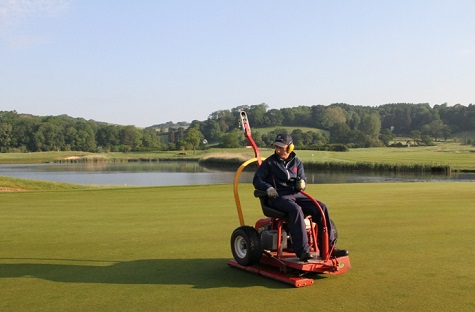
Turf ironing a green
However, today’s greenkeeping workloads are very different to the ones I was taught in the mid-1970s. Back then we cut the greens three times a week, tees once week and fairways once a fortnight. Today most run-of-the-mill 18-hole golf courses, are mowing greens daily, tees three times a week and fairways once or twice a week.
Also, the greens and tees will be Verticut, aerated, and fed on a regular basis along with a concoction of wetting agents, bio stimulants and other soil amendments. Some clubs will have a turf iron that they use to help firm up the greens prior to any match competitions. Even the fairways are scarified, fed and watered these days.
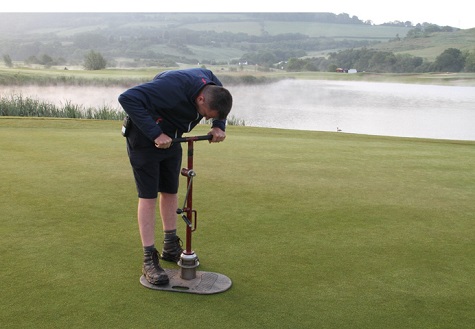
Hole changing at Celtic Manor
Hole cutting technology has also improved greatly with sophisticated motorised laser alignment systems to ensure holes are perfectly vertical and consistent in depth. We even have GPS tracking devices to record hole placements.
The fertilising regimes are quite complex now with a combination of slow release, granular and liquid feeds being applied more accurately with GPS guided spraying equipment.
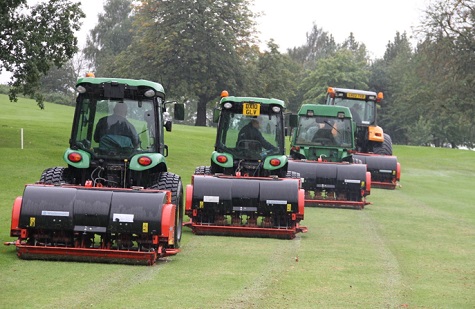
Contractor ALS Vertidraining fairways
As for aeration techniques we come a long way from the Patterson pedestrian spiker. We now have a wider choice and range of aeration equipment to hand, ranging from pedestrian solid and hollow tines self-powered machines to tractor mounted Verti Drain type machines. More recently we have seen a few deep probe compressed air systems, such as the Javelin, Robin Dagger, the now the popular Air2G2 come to market. Other machines include sand injection type machines.
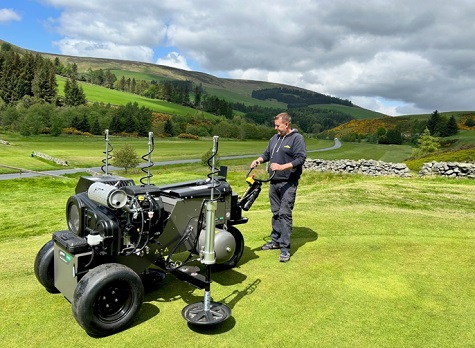
Foley Air2G pedestrian aerator
The Toro Procore 648 has also been a popular machine for golf clubs.
You can also read:
Part one of Cricket Through The Decades here.
Part two of Cricket Through The Decades here
Part one of my 50 years of football here
And part two of 50 years of football here.

