With the grass growing season now well under way, sports turf practitioners and others who want to maintain a healthy sward will be required to carry out several regular tasks to keep the sward fit for purpose, healthy and resilient.
These are generally centred around regular mowing, brushing, scarifying / verti-cutting feeding, watering and controlling pests, weeds and diseases.
Achieving a healthy grass sward in the UK requires an integrated management approach because UK turf faces constant pressures from the following influences - drought conditions, compaction, poor mowing practices, fluctuating temperatures, diseases, weeds and wear from excessive foot traffic.
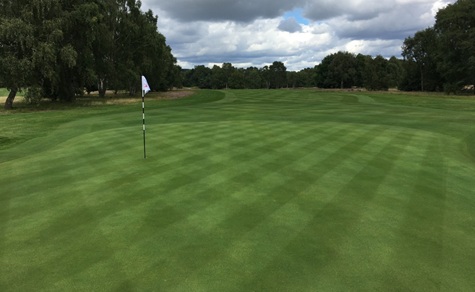
Generally, a healthy sward means you try to achieve a dense coverage, strong rooting, good vigour and colour and weed free.
For me personally, if you can understand the make-up of your soil composition and accurately identify your soil type, you will be better informed on the management regimes you will need to put in place to achieve and produce a healthy sward.
Understanding soil nutrient status is fundamental for healthy grass growth in the UK because turfgrass performance depends directly on the balance of nutrients, soil chemistry, moisture retention, and biological activity in the rootzone.
Understanding soil nutrient status matters because grass can only perform as well as the soil allows.
Good turf is not created mainly by mowing or fertiliser quantity - it comes from:
- balanced soil chemistry
- efficient nutrient availability
- healthy roots
- proper soil structure
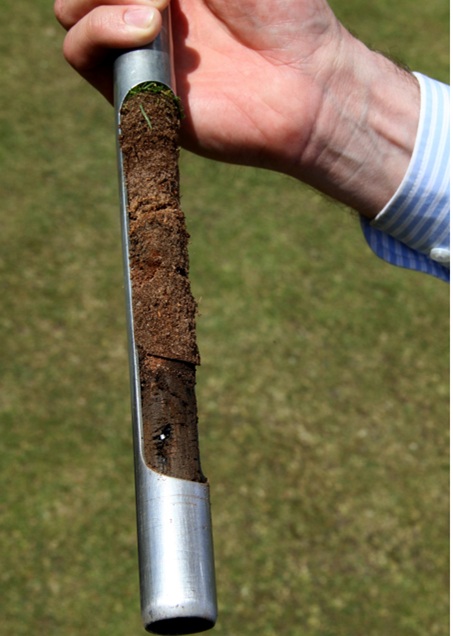
Knowledge and understanding of soil’s physical properties has always been important for turf professionals when making decisions about maintenance operations and when carrying out reconstruction works. Precise soil knowledge, including information on boundaries between soil types, should result in more efficient use of fertilisers, pesticides and improved management practices, thus ensuring that the final managed outputs result in the production of safe, consistent, playable natural sports turf surfaces.
Soils can vary in many ways, both physically and chemically on a local or regional scale. Many factors, including original parent material source, climate, weathering processes, topography or history of the land use, influence their properties. This soil variability gives rise to all the different soil types universally classified by soil texture composition. Soil composition (soil texture) is determined predominantly by mineral particles and organic matter content and can be classified by the percentage of sand, silt and clay mineral particle content.
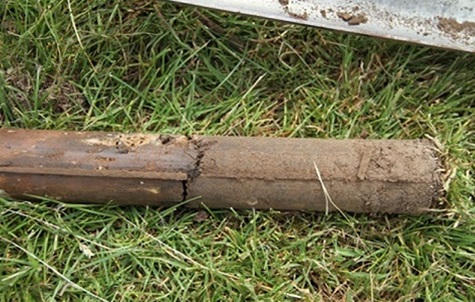
The strength and permeability of any soil is determined by its structure, soil type, drainage capacity and how well it is managed. Soils will perform differently governed by the amount of water, root mass and air there is in the soil matrix.
Determining soil texture can help you learn about possible restrictions and advantages of the soil. Soil texture is related to weathering and the parent material. The three basic texture classes are sand, silt, and clay, though many soils are a combination of these textures.
In the UK we have at our disposal several organisations that can help us identify what soils we have. One of them is the UK Soil Observatory that provides a soil mapping service that helps identify the predominant parent material soil by geographical location. However, taking a few localised soil samples from your pitches will easily identify your soil type. Once you have taken some soil samples and sent them off for analysis you will need to test for particle size and nutrient status.
Once you have determined your soil type based on the soil results of giving you a percentage of clay silt and sand using a soil textural triangle, you can identify what type of soil you have and how best to manage and maintain it to sustain plant growth.
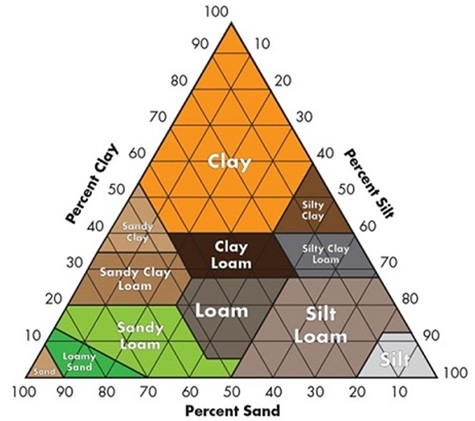
The Soil Texture Triangle, as shown above, helps us classify the soil type. These percentages are determined by undertaking a PSD, particle size distribution analysis.
The definition of soil texture is the relative proportion of sand, silt or clay in a soil. The terms sand, silt, and clay refer to relative sizes of the soil particles - sand, being the larger soil particle, feels gritty; silt, being moderate in size, has a smooth or soapy texture; clay, being the smaller size feels sticky.
Topsoil’s are complex arrangements of mineral particles, air, water, organic matter, living organisms and nutrients. The proportion of these elements is not always critical, however it is important that a soil contains all these elements in one form or another.
Topsoil is a major component of almost all natural sports turf facilities, the exception being pure sand constructed facilities. Its primary role is to provide a medium for grass growth that is both sustainable and stable. This sustainability and strength only comes about when the soil has a good structure.
The four major components of soil are air, water, mineral matter and organic matter. The relative proportions of these components greatly influence the behaviour and productivity/performance of the soils.
For accurate identification, you will need to take a few soil samples that will provide adequate material for a full soil texture analysis, pH test. nutrient analysis and an organic matter assessment. There will be a cost to send these away.
Proper soil sampling is critical for a reliable particle size analysis (PSA). Even the best laboratory test is useless if the sample does not accurately represent the soil profile.
In UK turf, horticulture, and landscaping, poor sampling is one of the biggest causes of misleading results.
Particle size analysis measures the proportions of:
So the goal is to collect a representative, uncontaminated sample of the rootzone.
Main principles of good soil sampling
You want to:
- avoid contamination
- capture a representative area
- maintain consistent sampling depth
Fine turf / sports turf
- 0–100 mm (rootzone)
- sometimes deeper profile testing:
o 100–200 mm
o 200–300 mm
Gardens and horticulture
- topsoil:
o usually 0–150 mm
- subsoil separately if needed
Never mix different depths together unless specifically instructed.
Take multiple cores
One sample is never enough.
For representative analysis:
- take 10–20 cores minimum across the area
- use a zigzag or “W” sampling pattern
This avoids bias from local variation.
The most reliable approach
For the most accurate UK turf or horticultural assessment:
- Divide the site into uniform areas
- Take 10–20 cores per area
- Sample at consistent depth
- Mix thoroughly into a composite sample
- Submit clean, labelled samples to a professional laboratory
That gives the most representative and actionable particle size analysis results.
Therefore, knowing your soils is an essential element that will help you understand and plan the correct maintenance regimes of your natural grass playing amenity facility.