CONTRACTOR'S KNOTWEED SUCCESS
Using Roundup ProBio
Specialist contractor The Knotweed Company Ltd says greater efficacy, improved rainfastness and reassuring safety has made Roundup ProBio from Monsanto their herbicide of choice.
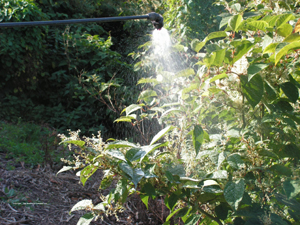
Japanese Knotweed spraying
With its head office in Northamptonshire, the company has depots across England and Wales and offers a countrywide service for control of invasive weeds. Clients range from householders to large organisations such as Church of England, MOD, banks and construction firms.
"We offer a complete weed control package for troublesome weeds such as Japanese Knotweed, Giant Hogweed, Bamboo and Horsetail," explains managing director Brian Taylor. "We take care of everything from herbicide application to excavation where it is needed, and since the new formulation Roundup ProBio was launched we have been very impressed with the improvements to a tried and tested brand."
Application services include spraying, stem injection and weedwiping, so Mr Taylor and his team have plenty of experience in using different chemicals.
"Roundup has always been an excellent product, very effective and safe to use, but the Roundup ProBio formulation is even better. It is rainfast in just one hour and the take up to the plant is much improved. It is also very safe so we can be confident about COSHH assessments."
The Knotweed Company Ltd takes every opportunity to control Japanese Knotweed, which has hit the headlines again this year. "We find that application of Roundup ProBio to the stems as well as or instead of the leaves offers improved targeting as the leaves can often be high up in the air, therefore treating the stems minimises the risk of drift and exposure for the operator." Mr Taylor explains.
"The stems also stay green longer - leaves typically fall in October, but in the south of the country stems may not begin to senesce until November or perhaps into December, so this potentially offers a wider application window with good results being possible later in the year."
Stem injection is another specialist area, and Mr Taylor cautions that while it can be extremely effective and is ideal where surrounding foliage needs to be protected, the technique requires skill and planning.
"First of all, the plant needs to be at the right growth stage with stems thicker than one inch at the base for effective treatment," he comments. "There is also the risk that if too high a dose is used, the Japanese Knotweed may become dormant and then you may find new growth up to 3m high a few years later. If treating a large area we tend to reduce application rates for better long term results."
|