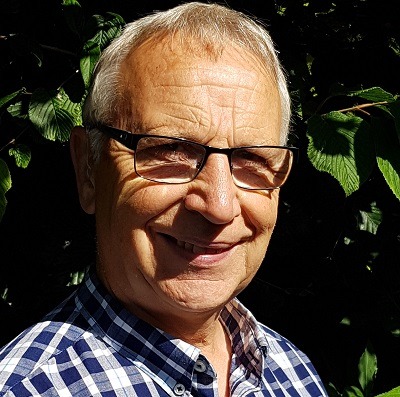
I recently took the opportunity to visit the Royal British Legion’s National Memorial Arboretum in Staffordshire, to meet up with Andy Ansell, head of estates, to find out what he and his team have achieved since his appointment some seven years ago.
I have personally known Andy since the early 1990s when he came to work with me at Telford & Wrekin Council. Since then he has built a distinguished career in parks, landscape management, environmental stewardship, and public green-space leadership. He is particularly well known for his senior roles with Glendale and now with RBL.
The skills he’s acquired have directly transferred into his work at the Arboretum. He now heads up a new management structure and oversees the maintenance and management of both landscape, memorials and building facilities on site, alongside leading on sustainability policy, safety and security. In the short time he has been there, he has helped draw up new strategies and plans to improve the visitor experience and efficient management of the site.
As a fellow national and international Green Flag judge he has helped the Arboretum achieve Green Flag status. The Green Flag Award is a non-profit international accreditation programme that recognises and rewards well managed parks and green spaces. Originating in 1996 - today the Green Flag Award proudly flies above more than 2,000 places in over 15 countries around the world.
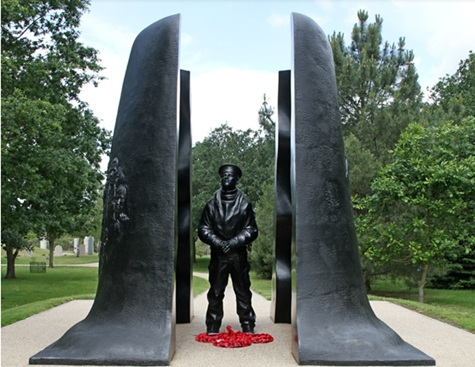
My appointment to see Andy was scheduled for 1pm. I made sure I arrived early morning, thus giving me enough time to walk around the 150-acre site and get some photos of some of the key memorials and landscape aspects of the site.
This year is especially significant for the Arboretum as they mark 25 years since opening to the public, celebrating a quarter-century as the Nation’s year-round place to remember.
Their founder envisioned a dedicated space to commemorate the service of the Armed Forces, Emergency Services and civilian organisations, and today they welcome more than 300,000 visitors each year, including 25,000 young people on learning visits.
The Arboretum employs a number of full-time staff but rely heavily on the recruitment of willing volunteers. Last year well over 260 people volunteered thousands of hours of their time at the Arboretum in 13 different roles, front and back of house.
Collectively the volunteer and staff teams work together to ensure that all of their visitors have a great experience when they visit the site.
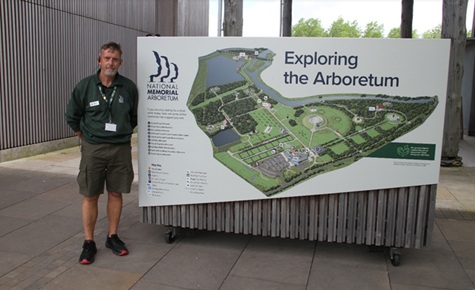
During my walk around the site, I bumped into one of the volunteers, Paul, an Armed Forces veteran, who kindly explained his role and how much he enjoys his job at the Arboretum.
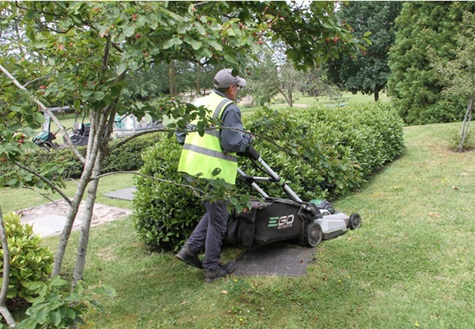
I also manged to talk to some of Andy’s staff who were mowing the vast grass areas around the site. I noticed all their machinery was battery powered.
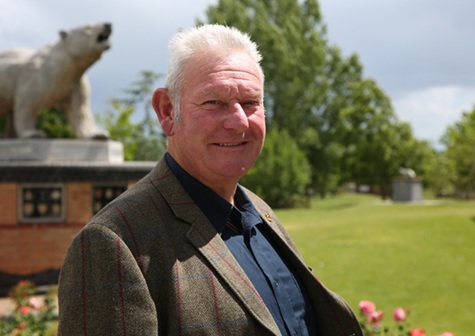
I made my way down to the Allied Special Forces memorial and was greeted by Mike Colton, a British military veteran, historian, memorial campaigner, and founder of the Allied Special Forces Memorial Grove at the National Memorial Arboretum.
Since 2003, he has led the development of one of the UK's most distinctive living memorial projects dedicated to Allied special operations forces and those who supported them.
The beginnings of the Grove began in 2003 when Colton and colleagues from the Allied Special Forces Association took responsibility for caring after an approximately three acre plot at the National Memorial Arboretum. Their vision was to create a living memorial combining remembrance, education, and nature. Rather than a single monument, the site was designed as an "open-air book" in which each memorial tells a story about special operations personnel, resistance fighters, civilians, and military units from the First World War to modern conflicts.
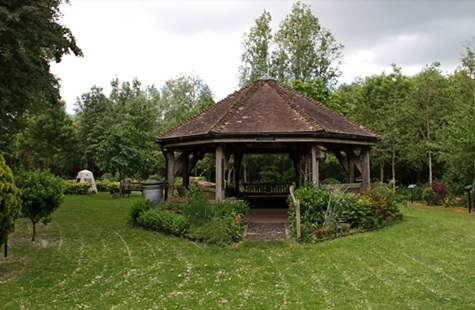
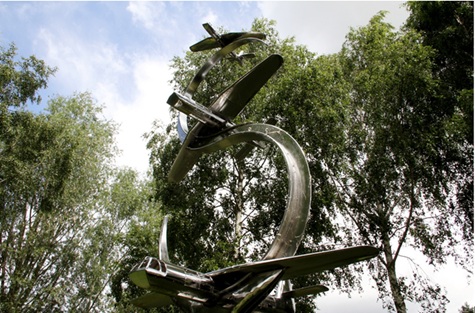
Mike was keen to give me a guided tour of the Grove and talked about the various memorials that he has created, including the Sunroom, completed in 2012 as the Grove's central gathering place, as well as the Pegasus Bridge Memorial Flight (2018).
Mike’s work extends beyond memorial construction. He has organised remembrance services, conducted guided tours of the Grove, researched special forces history, documented memorials, and promoted public understanding of lesser-known wartime stories. He rarely misses a day working at the Grove. They have their own set of machinery to maintain all the memorials and landscape features. Truly it is one man’s mission to honour all those of the allied special services.
The Grove remains a volunteer-supported, privately funded memorial project that continues to evolve under his stewardship.
For more information about the project, see the official website: Allied Special Forces Memorial Grove.
I made my way back to the restaurant just in time to meet up with Andy, who had finished his morning meetings, and we grabbed a quick cup of tea, before our interview and walk around the arboretum.
Our conversation focused on the management and maintenance of the memorial gardens, including grass cutting, memorial installation, and horticultural activities. Key metrics included 429 memorials (and growing), 8,500 individual dedication plaques, 650 benches, and over 25,000 trees.
Andy has a permanent estates team of twelve staff, of which eight work on the grounds under a manager reporting to Andy. The team has various horticultural qualifications, and training certificates. Well over 60% of the 150 acre site is mown weekly using a combination of ride-on and pedestrian rotary mowers. There is also a lot of strimming around obstacles, benches and trees.
To help with the workload Andy is supported by several volunteers a day who are willing to undertake maintenance duties. They also are certificated in the use of machines and equipment.
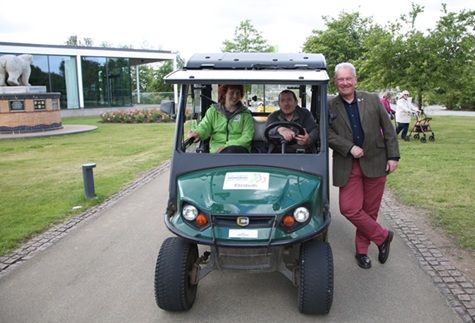
Virtually all the machinery and equipment are now battery powered apart from one tractor and Gator - something that Andy has instigated since his appointment.
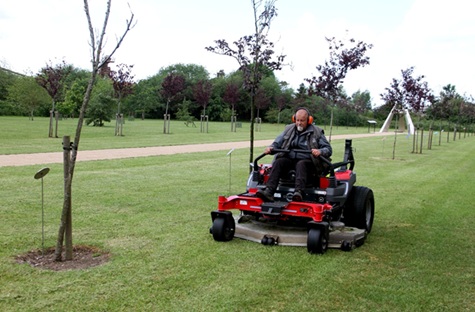
The machinery is quiet, with much reduced hand vibration. They have also recently replaced one of the ride on mowers with a battery powered Cramer rotary mower that can run all day on one single charge.
I chatted to Andy about his role -
TP. How often are you mowing the grass areas?
AA. We generally mow weekly throughout the growing season (March-September) maintaining a height of cut between 20-30mm. We don't run to a specified set of performance indicators for either frequency or outputs. Effectively I give the team the agility to do what looks right for the site.
TP. How many visitors come each year?
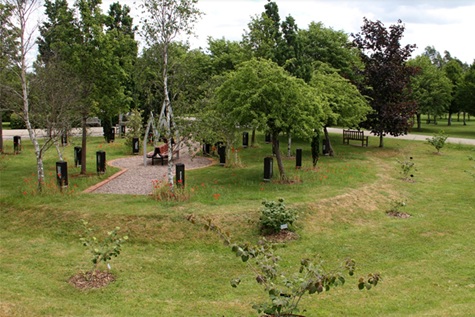
AA. The site hosts more than 300,000 visitors annually and 250-300 events, including major events like the Ride to the Wall. Future plans involve expanding the site and introducing new gardens and national plant collections.
We currently have two plant collections on site, the Hamamelis collection and the Amelanchier collection. We are looking to bring more plant collections to the arboretum in the coming years.
TP How many new memorials are created each year?
AA We look after over 400 memorials on site, and they come in all sorts of forms, shape and designs. Since I joined, I have overseen the installation of 50 plus memorials.
Each one must be approved by the landscaper and memorial committee. We generally help them through the whole process, to ensure it fits in and sits well with surrounding memorials and landscape features.
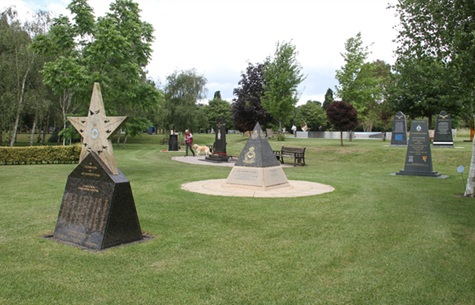
Depending on their size and scale they can take anything between six months and two years to come to fruition. They also come at a cost. Generally there’s a cost in the design and build of the memorial and then we charge an up-front maintenance and liability fee which will be based on the amount of time allocated to cleaning memorials, repairs and any landscape maintenance requirements.
Generally, we usually get between 8-10 new memorials a year, so we are kept quite busy.
TP. Who inspects and undertakes any tree works on site?
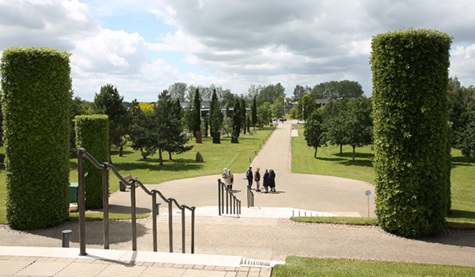
AA We try to do most of the work ourselves. As many of the trees are relatively small, we carry out regular tree inspections and maybe call in a specialist tree surgeon if required. We only remove dead, dying and diseased trees and are formulating a tree thinning programme to allow the better specimens to mature to their full potential.
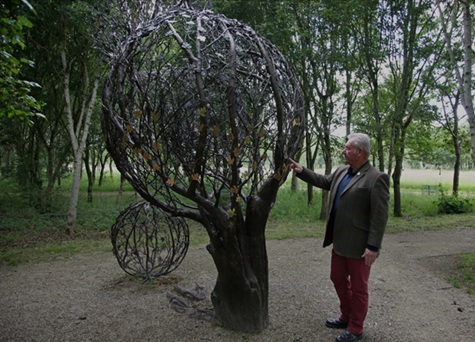
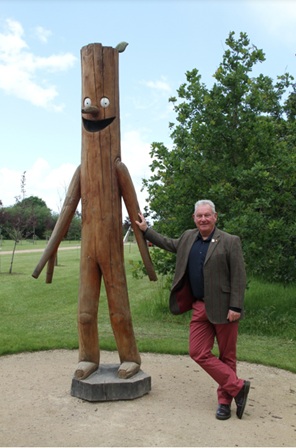
As for memorial plaques on trees, we have recently instigated the installation of a bronze tree (the Tree of Cherished Memories) that allows people to remember a loved one in a form of a metal leaf that is attached to the bronze tree for a period. It is becoming a popular feature in the Arboretum. We also have the Stick Man outdoor trail where we encourage children to come and learn about trees and nature.
TP. What future plans do you have for the Arboretum?
AA. Looking to the next 25 years and the next exciting chapter of our story as we become the Royal British Legion National Remembrance Gardens, we’re focused on further enhancing the visitor experience and creating even more opportunities for people from all backgrounds to engage with Remembrance.
This beautiful landscape has grown from what was once a sand and gravel quarry. Our founder started with what was just a collection of muddy fields.
Caring for the site is a year-round responsibility and there is always work taking place across the estate, even during the winter months when many trees and plants are dormant.
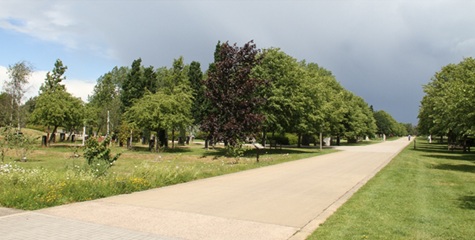
Volunteers are an essential part of our grounds team, with around 60 people supporting the work we do, alongside specialist contractors who assist with specific projects.
The future looks bright as we have another several hectares of land that we can develop in the coming years.
The last couple of years I have actively got involved with charity cycle rides. This year I will be pedalling nearly 300 miles following the journey of the battle of the Somme in July and pedaling 300 miles from London to Paris in September, both in aid of the Royal British Legion. So if anyone wants to support this charity you can donate on the following link Royal British Legion: Andy Ansell cycling challenges 2026 including the 30th Pedal to Paris.
TP. Thank you.
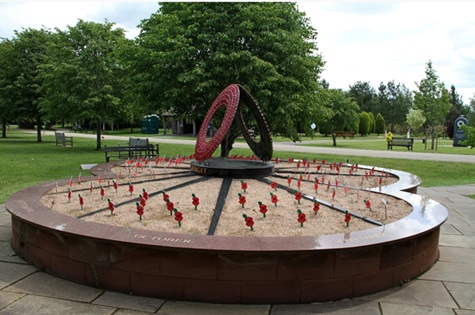
In September, the Arboretum will become the Royal British Legion National Remembrance Gardens, reflecting the evolution of the popular visitor destination over the past 25 years and the central role it plays in RBL’s vision to bring society together to recognise, remember, and support the Armed Forces community.
This follows the Arboretum’s full integration with RBL (the site’s parent charity since 2003) that is enabling sustained investment into the estate, building on the Arboretum’s success and legacy, helping create new opportunities for people to engage with Remembrance.