ADVICE FOR FERTILISER PLANNING
Five basic considerations
Planning a fertiliser program? Then there are five basic things to remember according to Headland Amenity's Andy Russell, who says that if you 'Fail to measure, then you should Plan to fail'.
The starting point when putting together a fertiliser program is a soil test to measure the available nutrients in the soil. This will provide an understanding of the existent nutrient status and also serve as a benchmark to compare future results. Without this, we have little idea whether the existing nutrients will be sufficient to maintain the plant going forwards.
A soil test will highlight any nutrient deficiencies or indeed excesses which can then be taken into consideration when planning fertiliser inputs. A quality soil test will also report, amongst others, organic matter content, cation exchange capacity (CEC), salt concentrations andpH. For consistent results, tests should be carried out at around the same time of year, but frequency will depend on the soil type in use.
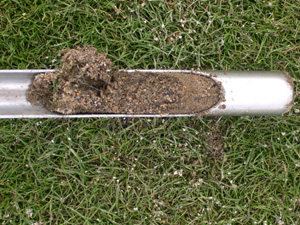
Soil sampling
When planning a fertiliser program it is important to keep it flexible.The growth and development of grasses is hugely influenced by the weather and, as we know, the weather is hugely unreliable. This means that the program produced for a 'given' set of conditions will have to adapt to accommodate weather extremes or fluctuations.The key is to have a good understanding of how each product works and why it is suitable under certain conditions.
Next, a strategic fertiliser program does not just take account of soil nutrient status and the needs of the grass plant going forwards. It also takes into account any management practices and practical elements that have an impact on the day-to-day running of the facility. Many clubs will hold an important tournament or event and will structure the program to make sure the turf is looking its absolute best at this point in the year.
Solid fertiliser products can be undesirable during the summer months as they may be easily seen within the sward if they don't break down rapidly, interfering with the playing surface. Liquid or soluble products might be more suitable during this period and can be applied rapidly and unobtrusively. A fertiliser program should also consider the application of products around planned aeration to ensure the turf is not stressed before the operation ensuring rapid and strong recovery post-maintenance.
With seemingly milder autumn and winter periods, plant nutrition through this time of year is key. Low rates of nitrogen can be applied where soil temperatures allow and growth is occurring. In addition, applications of plant protectant nutrients (e.g. potassium, calcium) can help to strengthen the plant and minimise stress.
Recent STRI research shows tailored nutrient input during autumn can help to manage disease during its most prevalent period. Without addressing turf nutrition, plants in warm winters can stress, weaken and lose colour making it more susceptible to disease and slower to respond in the spring.
Last but not least, the potential cost of any fertiliser regime must be established at an early stage and emphasis should be placed on getting the best possible results for the best cost. Fertiliser bag prices must be carefully compared as the amount in each can vary.
Another cost implication will result from the application rate used. High analysis products often have the advantage of being applied at lower rates (where granule size allows) - thus providing better value. Soluble fertilisers can be extremely cost-effective in comparison with some liquids, however they carry an increased time/labour element in preparation.
Clubs who can purchase materials ahead, and for the whole season, can reduce unit costs where cash flow allows.
|