Periodically throughout the year, I have the opportunity to test different makes of machinery. My latest trial was with STIHL’s BGA 300 cordless leaf backpack blower.
I currently have a STIHL BG 56 two stroke powered blower that I use for general cleaning up after garden maintenance work - and I have in the past trialed a number of other battery powered blowers.
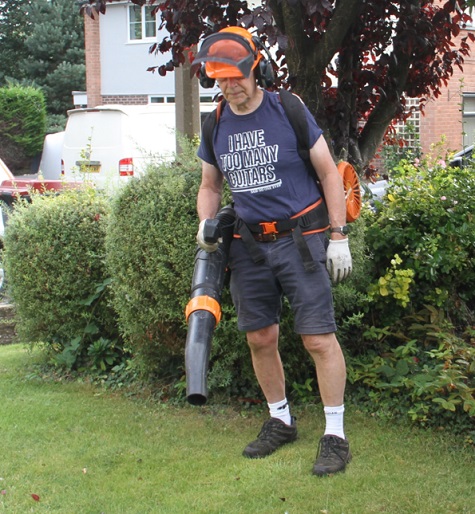
Turf professionals now have a plethora of battery powered blowers to choose from and they are becoming increasingly more efficient and powerful.
I tested the blower myself and also asked the estates manager at Harper Adams University, Mark Hall, to trial it at the campus to offer some feedback as well.
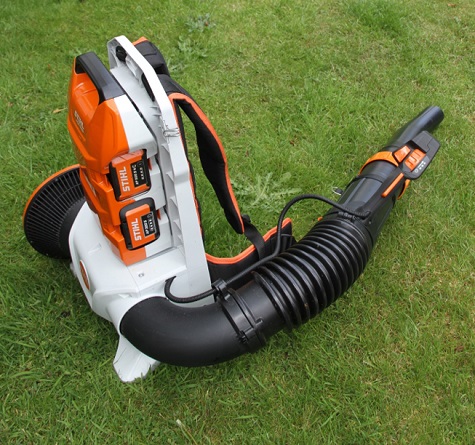
This blower is powered by the manufacturer’s ADA 1000 double battery slot adapter that holds two AP batteries. I was loaned two AP 500 S and two AP 300 S batteries to try out.
The blower features a brushless motor designed to offer three power levels plus a boost mode. The BGA 300 delivers 26 newtons blowing force and 192 mph air speeds for clearing of both dry and wet debris.
It has been designed with a noise reduction system that is suitable for noise-sensitive areas. It’s patent-pending silencer system keeps it at 94 dB (full throttle), making it one of the quietest power tools in its class.
Depending on your working requirements, the blowing force can be set to 4 levels, including boost mode. The selected level is indicated by the LEDs. Boost mode activates maximum leaf blowing power while the trigger button is held down, regardless of the preselected power level. Users can optimise the battery runtime by selecting the appropriate power level.
When carrying out extended working regimes you can lock the throttle at any preferred position, even between levels. This relieves the strain on your index finger during longer periods of continual use.
The length of the blower tube can be adjusted for use in narrow work areas or corners. You can also open and close the fastening of the blower tube by turning the ring.
The blower tube can easily be removed to make it easier for transporting.
Like many backpack blowers, they are often quite cumbersome to lift and get on your back - but once in place and secured by the support straps, they become comfortable to wear and easy to use.
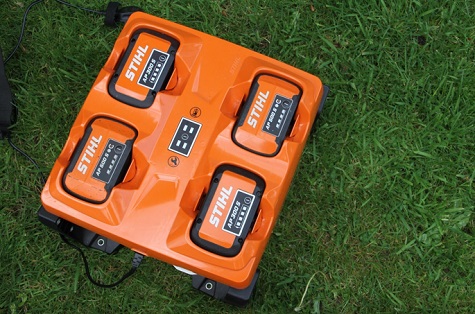
I was also given to try a STIHL AL 301-4 multiple battery charger.
The batteries were quickly recharged using the multi-charger, taking between 30-90 minutes depending on state of the batteries. Each battery has a power light indicator to let you know the state of the battery and when it needs recharging.
I personally found the blower to be quite powerful. In fact the BGA 300 at 26 newtons has double the blowing force of the BG 56 at13 newtons. Once it is on your back I found it a pleasure to use. You can easily change the blowing speed with the ergonomically designed hand controls.
The backpack blower is suitable for carrying out longer periods of leaf clearing work. I found the noise levels and hand vibration to be low compared with petrol powered blowers.
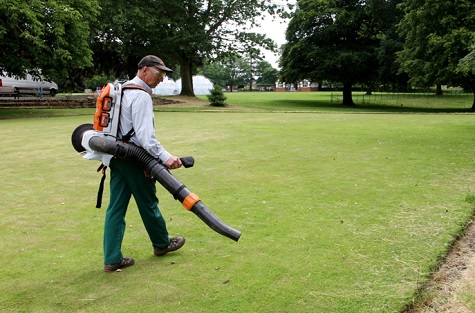
As for Mark’s thoughts on the blower, he had it for a couple of weeks enabling himself and his staff to try it around the University complex, clearing up debris and keeping paths clean.
The feedback I received from him was interesting, as he was able to compare it with their existing petrol version of the same blower.
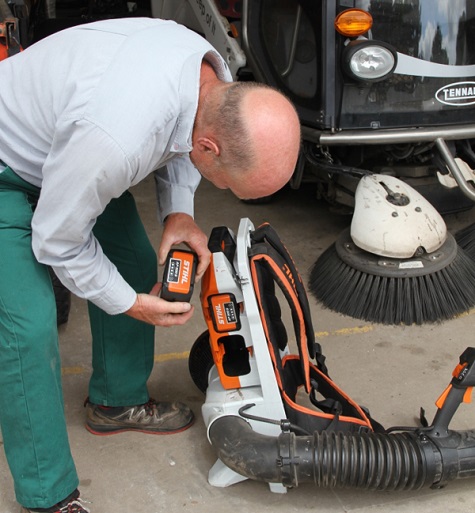
What Mark liked he said, was that it was quicker to set up and use. “There was no need to spend time filling up with fuel and having to start it, before putting it on our backs,” he told me. “Often the petrol version takes time to get going and quite often will cut out and you then need to take it off your back to restart it. All time-consuming chores. Whereas the battery powered blower starts instantly.”
However, Mark felt that the downside of the battery powered blower was that the batteries soon ran down when in constant use, with the need to recharge. “Our petrol version can run generally for a couple of hours before needed to be refilled,” Mark said.
Mark told me he felt the battery blower was comparable in terms of power as the petrol version, but much quieter and with less hand vibration. His staff also commented on how quiet and less polluting than the petrol machines the battery unit is.
Mark said it would be a good acquisition for use around dormitories and classrooms when there is a need to reduce the noise levels of maintenance machinery.
He also told me he was impressed with the ADA 1000 battery carrier that holds the two AP batteries. “It means that we can utilise their other AP batteries to power the blower,” he said. “It is also much lighter than the AR 3000 L battery unit.
Conclusions
I would say this is a robust and simple machine to use, with plenty of adjustability on both the harness and the blower to ensure its comfortable for the user.
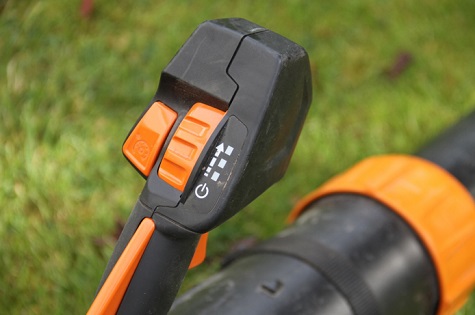
Hand controls are simple and as for battery run times, it all depends on the work and setting on which you use the machine. For me, I got a fair amount of work done using the two AP 500 S batteries, whereas the staff at the University were somewhat disappointed with the run times when in constant use.
When comparing it to a petrol driven blower, the cost of buying a battery powered product is generally higher. However, you are essentially paying up front for your fuel (the batteries). On top of this I believe you are gaining a number of advantages in operational benefits in that it’s cleaner, quieter and with less hand vibration.
I am sure many professional users will convert to battery powered blowers in the coming years.

