EDITOR'S BLOG
A GREAT NETWORKING OPPORTUNITY
At SALTEX last week
by TurfPro Editor, Laurence Gale MSC, MBPR
 
Laurence Gale MSC, MBPR

The GMA's show at the show afforded me the chance to meet up with many of our wonderful turf professionals - but the question remains as to how to up our trade show attendances in general.


I attended the Saltex show at the NEC Birmingham last week and, as always, it was a joy to catch up with many fellow turf professionals and of course the many exhibitors that continue to support our trade shows.


The layout of the show seemed more spacious this year, with larger stands on display and wider walkways. It was difficult to judge how busy it was compared to previous shows. I attended both days and there was a busy spell around late morning to about 1pm each day.


Kubota's stand


Talking to both traders and punters there was a mixed feeling about the show in terms of what was on display and the ongoing commitment to support trade exhibitions. Some exhibitors had vastly reduced their stand space to save expense and time in bringing large amounts of equipment to the show. Others had taken the opportunity to expand their space.


The Kress stand 


It will be interesting to hear the final, official attendance figures for the show, but I would guess it’s likely to be around the 6000 mark over the two days - the normal average for our current industry trade shows. The question our industry needs to ask itself now, I believe, is how we can improve the attendance figures for all our trade events. For many years they have remained stagnant. 


One major issue I see, is that we have lost interest from local authorities. They, and other large organisations, now tend to buy machinery through procurement processes, meaning fewer council employees come to these shows. 


GKB stand 


The days are gone when people turned up at trade shows and placed direct orders with the manufacturers or dealers. Most business is now done outside of the trade shows. Our events are now primarily a shop window to see some new products. 


Personally, I think it is important for all practitioners and managers to attend these shows; one, to support the industry; two, to keep abreast with the array of services and products now available; and three, for the opportunity to meet up and network.


For me it’s the people that make our industry what it is today. We are all going through our individual career paths, and it is the passionate driven people that change and shape our industry. It was nice to meet so many committed industry professionals all doing their bit to drive, maintain and manage our living spaces. 


L-R Toby, Simon and Lee


During the two days I caught up with many industry champions who have dedicated their lives and have successful roles in delivering services and products to the end users. It was great to catch up with Toby Clarke of SIS Pitches and formerly Dennis / Sisis, Simon Gumbrill  SGL and Lee Morgrado , Campey Turfcare who have risen through the ranks and become successful in driving our industry forward. 


Toby has just taken on the role of global sales director for SIS, whist Simon is the  global key account manager for SGL. Lee meanwhile spent many years working for Campey Turfcare under the supervision of Richard Campey and now has the role of director with the company


Lee with the new Sarel Roller


On their stand, Lee was keen to show me their latest product, an electric sarel roller -  a robust, 60 cm-wide aerating roller designed to improve soil health and optimise grass growth on areas up to 3,000 m². Using 70 sharp, durable spikes, the roller precisely penetrates the soil 223 times per square meter, increasing air circulation and water absorption. Which would be a good acquisition for bowls, cricket and golf clubs. 


L-R: Geoff Burgess, Derek Walder, and Geoff Webb, GMA 


Other industry leaders at the show included, of course, the GMA leading lights Geoff Burgess, Derek Walder and Geoff Webb who were walking around the show, pleased with the turn out.


L-R Stuart, Paul and Andy


I also manged to catch up another three stalwarts Stuart Yarwood, DLF, Paul Lowe Aquatrols and Andy Ralphs, HG Delemere Forrest GC - all long-standing pals who started their careers as greenkeepers.  


This theme of meeting people continued with a large contingent of Wolverhampton ground staff under the leadership of Wayne Lumbard, the HG at Wolves.


Wolves' grounds team 


I also manged to catch up with Richard Brown from Germinal Seeds who have supported our trade shows for many years. 


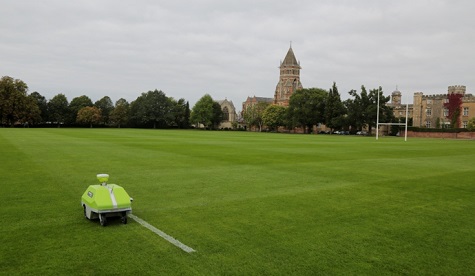
As for products, there was plenty to see at the show, with robotic mowers taking centre stage with a plethora of examples on show. Both robotic line-markers and mowers are now becoming widley used. Origin with their Tiny Robots line-markers told me they have sold over 400 units to date, with them becoming popular with schools, contractors and rugby / football clubs. My local rugby club for example, have recently acquired one and tell me it has made a great difference to the presentation and efficiency to the marking out of the pitches. 


Origin's Tiny Robots on show 


Husqvarna's robotic mowers 


Golf courses and large estates are more confident in purchasing robotic mowers now they have better understanding of what role they can play - combined with their increased reliability, their ability to cut grass at specific heights, their safety features and the fact that they can work at night.


The concept of using robotics is only going to get more popular in the coming years. We already seeing a number of golf course investing in robotic mowers to cut their fairways and other general areas that frees up the labour to do other jobs around the course. 


Todd Harrison, Andy Silvey and Ian Sommerville, RFU pitch advisors 


I also caught up with some of the GMA pitch advisors who were on hand to give advice to many of the attendees at the show. There are plenty of loans and grants now available for machinery and pitch improvements.


Far right, Jim Clarke 


As for other visitors, I caught up with Jim Clarke from Fine Turf Machinery, a dealer in Shropshire who sells a range of professional products that include Dennis/ Sisis and Kress products who was walking around the show with his two mechanics.


All in all, for me it was a good event for enabling me to network and catch up with fellow work professionals - hopefully gleaning some potential articles for TurfPro in the coming months.


As for our trade shows in general, I personally think we are missing a trick in not inviting schools and colleges to attend the last day, with the aim of giving them the experience of seeing what our industry is all about. This would clearly boost attendance figures but, more importantly, raise the profile of our industry. I also think we should be trying to get top professional sports personalities to attend and support the show.


Lizzie, Annie, Duncan and Nikki on our stand 


Finally, I must mention my  work colleagues Keith, Steve, Lizzie, Annie, Duncan, and Nikki who helped man the TurfPro and Service Dealer stand throughout the duration of the show.

NEWS
ASKING FOR OPINIONS FROM ALL
On structure and role of trade association
 
A survey is now live

In our first WEB ONLY story, the Association is running a survey, open to all greenkeepers. that they say is intended to ensure that members are at the heart of plans to develop their activities and structure.


WATCH EQUIP SPECIAL REPORT TEASER VIDEO
Available now
 
Equip teaser video now available

Watch a teaser video of TurfPro, plus Jo Balmer of Balmers GM, at the world's largest outdoor power machinery exhibition in Louisville, Kentucky.


A teaser video is now available of TurfPro, plus Jo Balmer of Balmers GM, at the world's largest outdoor power machinery exhibition in Louisville, Kentucky, Equip.


The full Digital Special Report, packed with interviews, insight and more, will be published soon. Keep an eye on the Weekly Briefing and our socials for details.


Watch below or via TurfPro's YouTube channel.


Equip Exposition Special Report 2024


EIGHTH HALL OF FAME INDUCTEE
GMA bestow honour
 
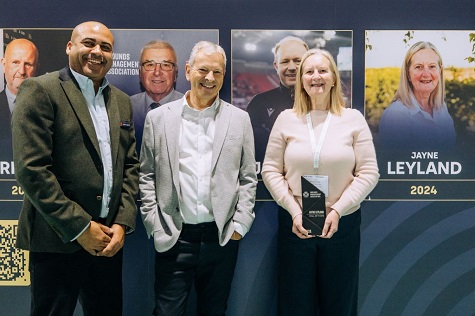
Jason Booth, Geoff Webb and Jayne Leyland

In our next WEB ONLY story, the award recognises inductee's outstanding contributions and long-standing dedication to advancing the turfcare industry.


GLOBAL PRIZE FOR CAMPEY
Impact on world stage honoured
 
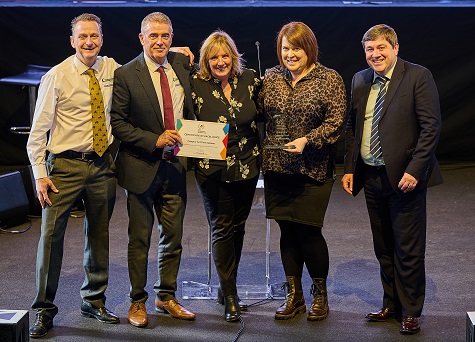
L-R: Campey's Richard Heywood, product specialist; Brian O'Shaughnessy product specialist; Mandy Caton administration, Julia Campey managing director; and Joe Brennan, managing director of award sponsor Bio Pharma Dynamics

Company say they have developed an ethos of solving the challenges turf professionals face in the UK, and by applying that worldwide, have built their reputation.


Campey Turf Care Systems' impact on the world stage, has been recognised by the Greater Manchester Chamber of Commerce (GMCC) with the 2024 Global Star Award.


L-R: Campey's Richard Heywood, product specialist; Brian O'Shaughnessy product specialist; Mandy Caton administration, Julia Campey managing director; and Joe Brennan, managing director of award sponsor Bio Pharma Dynamics


The Macclesfield-based company received the accolade during the GMCC Excellence Awards at Manchester's Albert Hall, with its achievements in innovation and global business growth recognised.


Campey say as sport has grown globally, so has the demand for high-quality surfaces. They say they have developed an ethos of solving the challenges turf professionals face in the UK, and by applying that worldwide, have built their reputation. 


The GMCC Excellence Awards showcase and celebrate business achievements and resilience, highlighting businesses, leaders, and teams that have demonstrated success within their industries and communities in Greater Manchester.


Speaking about the recognition, managing director Julia Campey said, "Winning the Global Star Award is a testament to our entire team's hard work and dedication. We are proud to represent the turf industry on the global stage, and this award highlights our commitment to continually delivering exceptional service and driving innovation in the turf care industry."

DEALERSHIP APPOINTED FOR POWERLAND
Electric ATVs
 
J&R’s Jonathan Philp and Richard Trengove

Dealership says the appointment allows them to offer their customers an environmentally friendly alternative to fuel-powered ATVs.


Boss ORV has announced the appointment of J & R Agricultural Engineering Ltd. as Powerland dealers.


J&R’s Jonathan Philp and Richard Trengove


Based in the Looe area of south east Cornwall, J & R were appointed in April 2024 as dealers for the Boss distributed Corvus Off-Road Vehicles. The dealer has over thirty years in the industry as a tractor and machinery sales and repair business, latterly incorporating ATV and UTV sales and service. They will now add the Powerland Tachyon all-electric ATV to their line-up. 


“It is a natural extension for Jonathan Philp and the J&R team to sell Powerland,” says Neil Everett, BOSS ORV’s national sales manager. “They will provide coverage across Cornwall and South Devon for this exciting new electric ATV.” 


J&R’s Jonathan Philp, added, “We’re very pleased to be appointed as Powerland dealers. The Tachyon allows us to offer our customers a real environmentally friendly alternative to fuel-powered ATVs.”

JOBS
TERRITORY SALES MANAGER - SOIL SCOUT - MAYA
Bernhard and Company
 
Bernhard

As a leader in smart land management solutions, Maya Global combines technological excellence with a dedication to advancing the future of agronomy and sustainability.


About Bernhard and Company


Bernhard and Company’s considerable knowledge and understanding of turf and its horticultural requirements stems from a long immersed history in the sector. Stephen Bernhard, founder of Bernhard and Company, developed a special interest in the technical issues surrounding the mowing of turf. 


In particular, this included the critical effect that reel grinding techniques had on mower performance, maintenance time and cost and on the quality of turf that resulted from alternative approaches.


Bernhard and Company leads the way in providing turf health solutions to the industry and our partners.


Our best-in-class products, training and support partnerships deliver exceptional performance to sports venues worldwide.


About Maya


Maya Global is at the forefront of transforming land management through innovative technology and deep industry expertise. Harnessing cutting-edge AI and advanced data analytics, the platform provides actionable insights for effective management of land and resources.


The solution integrates real-time soil sensing, weather data, and predictive modeling to support sport ground managers in optimising operations and advancing turf management practices. With a commitment to user-centric design and operational efficiency, Maya Global empowers professionals worldwide to achieve exceptional results and drive sustainable change in their fields.


As a leader in smart land management solutions, Maya Global combines technological excellence with a dedication to advancing the future of agronomy and sustainability.


Responsible for:

  • Achieving sales targets and growth of business for Soil Scout and Maya
  • Developing and submitting territory sales plans
  • Identifying and managing new business opportunities
  • Developing new business initiatives and strategies to maximise sales opportunities
  • Maintaining operating costs with the area budget
  • Competitive intelligence 

Duties and responsibilities:


Establish annual business plans, strategies, and in-field activities to achieve agreed sales targets. These can include demos, seminar events, customer training,...etc.


Plan and establish area sales forecast and annual sales goals. 


Assist in the execution of annual sales goals by:

  • Sales support activities
  • Identify, monitor, and maintain opportunities through company CRM
  • Aid at local exhibitions/conventions/association events
  • Assist with coordinating support/service activities to correct product issues
  • Develop and manage relationships with prospects and current customers
  • Scheduling and making regular visits with prospects and current customers
  • Assist with negotiating orders with customers
  • Coordinating field visits to customer locations and key accounts
  • Assisting with introducing new products and services

Assist Bernard and Company and Maya by:

  • Attend manufacturer training as required to maintain expertise and skills related to products and sales processes
  • Report on competitive activity and new product introduction to the market
  • Support / attend trade shows, activities, demos, meetings, field days, etc., as necessary
  • Operates remotely with or without administrative support by answering customer calls, maintaining opportunity tracking, scheduling meetings, planning travel, utilizing CRM, and generating reports as needed
  • To act in the best interests of the Company
  • Represent the Company positively
  • Perform other special assignments and duties as may be required 

Compensation plan:


The basic salary will be dependent on experience


In addition to the basic salary an additional range of bonuses will be offered based on targets reached. This will be further discussed with the potential candidate.


Included vacation time is 23 days per annum plus all observed UK bank holidays


Company car


We will reimburse all business expenses legitimately incurred in carrying out your role. You will be provided a company credit card for all travel expenses including hotels, meals, rental cars, flights, customer entertainment, etc. A company provided laptop and cell phone will also be included. 


All salary payments are paid monthly 


The ideal candidate will have several of the following:


  • 2 or more years of industry experience
  • Self-motivated and able to work independently
  • Organised
  • Strong communications skills
  • Knowledge of Microsoft Office applications
  • Previous sales experience preferred but not required
  • Comfortable with presenting in front of a group
  • Must live in the designated territory

To apply click here

ADVERTISE YOUR JOBS HERE
Amazing success rates!
 
Advertise your jobs on TurfPro Weekly Briefing

Advertise your recruitment needs on TurfPro Weekly Briefing and reach our targeted audience of recipients every week.

Contact Nikki Harrison for details - 01491 837117


PREVIOUS FEATURES
EDITOR'S BLOG ARCHIVE
Catch up with Laurence Gale's recent blogs
 
TurfPro editor, Laurence Gale

Want to catch up with one of editor Laurence Gale's blogs? Here is the place to do so.


TURFPRO FEATURE ARCHIVE
Find our previous features here
 
TurfPro Feature Archive

If you want to catch up with any of TurfPro's previous features, here is the place to do so.


PLACING URBAN GREEN SPACES AT THE HEART OF INFRASTRUCTURE
Midlands Parks Forum's annual conference


RAISING THE VOICE
At the Amenity Forum's annual conference


SUSTAINABLE PARKS
Parks For London case study


WHY GRASSROOTS RUGBY IS IN DECLINE
A steady drop off in participation.


SEEDS OF SUSTAINABILITY
Focus on a major supplier of grass seed and related products to the amenity sector


ON TEST
STIHL BGA 300 cordless leaf backpack blower


ON TEST
EGO Multi-tool


PUT THEM ON THE TOOLS!
Time for an attitude change


SUSTAINABILITY IN THE TRAINING SECTOR
Grasping the challenge of encouraging more sustainable practice


SUSTAINABILITY IN LOCAL AUTHORITIES
Lessons learnt and experiences


SKILL SETS NEED RECOGNITION
Turf professionals are underappreciated


GREATER RESPECT FOR GROUNDS STAFF MIGHT MAKE ALL THE DIFFERENCE
To the recruitment crisis


A COMPETITIVE SALARY
Why employers should advertise the salary when recruiting new staff


ON TEST
Makita XGT UV001G lawn scarifier


AN EXAMPLE OF SUSTAINABILITY IN MACHINERY SUPPLY
Focus on Kubota


MY PERSONAL GREENKEEPING PHILOSOPHY HAS NEVER CHANGED
I don't follow any set program


SUSTAINABILITY IN LANDSCAPING
A substantial element of amenity activity


IS IT TIME TO SAY NO TO 'NO MOW MAY'?
Any real benefits?


SUSTAINABILITY IN OUR PARKS & PUBLIC GREEN SPACES
Meeting the challenge


THE PATH TO WIMBLEDON
For groundstaff member, Conrad Cavil


ON TEST
EGO LBP8000E backpack blower


SUSTAINABILITY IN THE LAWN CARE SECTOR
A key consideration


BEEKEEPING IN COMMERCIAL ENVIRONMENTS
The current situation


SUSTAINABLE PRACTICE IN THE AMENITY SUPPLY SECTOR
Optimising land use through integrated solutions


SUSTAINABILITY IN THE GOLF SECTOR
Focus on BIGGA


THE SEARCH FOR SUSTAINABLE PRACTICE
Bringing together key points


DEVELOPING SUSTAINABLE SOLUTIONS FOR GOLF
R&A are supporting clubs


GETTING THE MOST OUT OF EVERY POUND OF BUDGET
A course manager's view


A NEWFOUND APPRECIATION FOR ALL VOLUNTEERS
Who look after grassroots pitches


SUSTAINABILITY & THE UK ACTION PLAN
For weed, pest and disease management


CONCERN FOR PARKS FOLLOWING COUNCIL BANKRUPTCIES
What does the future hold?


TAKING A GLOBAL LOOK AT SUSTAINABILITY
Is the rest of the world also driving towards sustainable practice?


RENOVATIONS, PLAY AND THANKS
On my mind this week


SUSTAINABILITY – IMPLICATIONS FOR TRAINING & EDUCATION
Set to play a crucial role going forward


TULIP TREE
Liriodendron tulipifera


LYDIA BROOM
Genista lydia


THE LAWN AND ITS VALUE
Changing attitudes


GIANT HOGWEED
Invasive and potentially harmful


LIFE-CYCLE ANALYSIS & SUSTAINABILITY
Considering every stage of the journey


NITROGEN USE EFFICIENCY
The most important nutrient


BERBERIS THUNBERGII
A shrub that has stood the test of time


ENSURING FUTURE PROSPERITY
Advice imparted at road shows


INNOVATION & SUSTAINABILITY
A key focus


PHOTINA RED ROBIN
A sensational flowering shrub


VALUING THE GRASSROOTS
We must not overlook those who maintain these grounds


MANAGING WEEDS SUSTAINABLY
In amenity spaces


DETECTING NUTRIENT DEFICIENCY SYMPTOMS
In turf plants


SPRING RENOVATIONS UNDERWAY
A crucial period


SUSTAINABILITY IN SUPPLY
A focus on those who supply essential inputs to our sector


CHANGING CLIMATE
Is a borehole the key for clubs?


SUSTAINABILITY AT THE SHARP END
How to put into practice when budgets are tight?


ANOTHER NAIL IN THE COFFIN OF GRASSROOTS RUGBY
Clubs are struggling


SUSTAINABILITY IN PRACTICE
Seeking transparent and robust supply chains is essential


TIME FOR ACTION
To reverse recruitment crisis


CONTROLLING COSTS
Planning is crucial


THE SEARCH FOR SUSTAINABILITY
What exactly does the term mean?


CARING FOR THE GRASSROOTS
From volunteers to contractors


DEFRA IS LETTING DOWN THE COUNTRY
Complete failure to address the plastic grass debate


WE CAN ALL DO MORE
To aid biodiversity


MY LIFE IN GREENKEEPING
With Bruce Cruickshank


LEVELLING UP, GETTING SMARTER & GETTING AHEAD
Parks require so much more funding


SWITCHED ON FOR HARD WORK
Putting trimmers through their paces


MACHINERY HIGHLIGHTS
At this year's show


MY SALTEX
Daniel Lewis​, Manchester City Football Club


AWASH WITH LEARNING OPPORTUNITIES
Two months till showtime


LOOKING BACK, LOOKING FORWARD
Priorities for the amenity sector


THE DECLINE OF ‘PARKITECTURE’
A symptom of the state of parks in 2022


DEVELOPERS SHIRKING GREEN SPACE RESPONSIBILITIES
Lack of financial commitment


TIME TO COME TOGETHER
For the good of the industry


THE DEATH OF GRASS ROOTS CRICKET
Gathering apace?


ROUTES INTO THE INDUSTRY MUST BE ENSURED
Q&A with David Fisher, Lantra’s head of industry partnerships


STRONG VIEWS ON CRICKET PITCH PERFORMANCE MARKING
A bone of contention


A PREMIUM PRODUCT
Delivered at Naas Golf Club


THE GREEN REVOLUTION
And Esker Hills


MAKING A CHANGE
Laytown and Bettystown Golf Links


A DAY AT THE RACES
Naas Race Course


WORKING TOGETHER AS ONE VOICE
How the industry needs to proceed


OVER 175 YEARS OF EDUCATION
Wesley College


ELECTRIC EXCITEMENT
Dennis's Ian Howard talks electrification


THE HOME OF CORK GAA
Páirc Uí Chaoimh


LONG POLE BATTERY HEDGE TRIMMERS TESTED
STIHL HLA 66 and HLA 86


OVER 800 YEARS OF HISTORY
Johnstown Castle and Gardens


A CLUB GONE WILD
Kilkenny Golf Club


A GOLF COURSE IN THE GARDEN OF IRELAND
Woodenbridge GC


80 YEARS YOUNG
Charleville Golf Club


AN UPLIFTING EXPERIENCE
Bunclody Golf & Fishing Club


GETTING BACK TOGETHER
Albeit gradually . .


GO WEST
Inishturk GAA pitch – one of the most westerly sportspitches in Europe


WORKING ON A TIGHT BUDGET
Nenagh Golf Club


ON A MISSION
Wrekin Golf Club aiming to enrich wildlife and fauna


WILD AND WONDERFUL
Design By Nature


LEARNING HOW TO SURVIVE
Abbey Par 3


TACKLING OBESITY
Vital that schools can provide sport


A LIFETIME OF LEARNING
Vital for turf professionals


CELEBRATING 125 YEARS
Tullamore Golf Club


UNIVERSITY CHALLENGES
At Trinity College Dublin


BLENDING THE OLD WITH THE NEW
Bray Golf Club


A WELL POLISHED COURSE!
Ierne Social And Sports Club


IDENTIFYING THE TRUE VALUES
Of grounds maintenance


THE INDUSTRY WILL CHANGE & ADAPT
But it will survive


WIRRAL GOLF COURSES SAVED
Renewed hope and optimism for the future


GREEN SPACE CONTRIBUTION TO WELLBEING IS UNDERVALUED
Parks invisible on national agenda


A SHINING LIGHT IN IRELAND'S SUNNY SOUTHEAST
Wexford Golf Club


GREEN SPACES DO NOT LOOK AFTER THEMSELVES!
Keith Kent says we must invest in people


WE SHOULD TELL THE WORLD ABOUT THE UK INDUSTRY
Right time for all sides to come together


SOIL LIFE IS PRECIOUS
Good-quality soil can help save the planet


MORE THAN JUST CUTTING GRASS
Encouraging the next generation


A BUZZ FROM DOING THE JOB
Wide experience of the turf grass industry


PAYING THEIR WAY
Low wages is the bane of the industry


AMENITY MANAGEMENT IMPACTS US ALL
Professor John Moverley


CARING FOR PARKS OF ALL TYPES
Mary Worrall


TOP FIVE FRUSTRATIONS FOR CRICKET GROUNDSMEN
What causes you the most frustration in your role?


PROFESSIONALS AT THE CUTTING EDGE
Vic Demain and Phil Sharples


BOWLS CLUBS IN PERIL
A sad decline


A VERY SPECIAL INDUSTRY
Loz looks back


SNEAK PEAK AT A ROBOTIC "GAME CHANGER"
Commercial model capable of covering 50,000 m2 teased


HALESOWEN PICK A BIG ROBOT UP FRONT
Invest in mowers


COMPRESSED AERATION
The new way


PARKS MATTER MORE THAN EVER
Recent sector developments


ON TEST
STIHL blowers


THREE CORE VALUES TO SHAPE OUR INDUSTRY
Real concerns for the future


ENGLAND'S GREEN SPACE GAP
A split along racial lines


ON TEST
EGO STX3800 strimmer with RTX2300 Rotocut head


A SECTOR FACING IMPORTANT TIMES
Review of the National Action Plan


PARKS MATTER
The role of public parks in the recovery: a discussion paper


A UNIQUE SPORTING VENUE
Wormsley private estate


A BTME OUTDOORS?
A good bet for the industry


PARKS NEED APPROPRIATE POLITICAL REPRESENTATION
Q&A with Philippa Reece, Parks and Foreshore Manager at Adur and Worthing Council


CRICKET LOAM
What does it mean?


A HERCULEAN EFFORT TO GET PARKS BACK TO NORMAL
Q&A with Chris Worman, Rugby Borough Council’s parks and ground manager


ON TEST
STIHL battery products


TURFGRASS STRESS MANAGEMENT
Reactive Oxygen Species (ROS) and antioxidants during biotic and abiotic stress in turfgrass plants


AUTUMN DISEASE MANAGEMENT
The coming months are going to prove very difficult


THE ABUSE OF PARKS . .
Is the abuse of society


WHY PARKS MATTER?
A statement from the Parks Management Forum to the Prime Minister


THE 21st CENTURY PARKS MANAGER
Innovative, creative and entrepreneurial


EAT, SLEEP, CUT, REPEAT!
Cricket under covid


TIME FOR A SINGLE SHOW?
Debate brought back into focus


A CHALLENGING TWO MONTHS
Running golf design projects from home


PRESSURE SITUATION
Cementing the reputation


A CLUB TO BE PROUD OF
10 years at the helm of Olton GC


GAME CHANGERS IN TURFCARE
The day the Lord's outfield reconstruction proved its worth


THE ESSENCE OF ESSENTIAL
Finding a sensible way forward on defining "essential maintenance"


THAT WAS THE YEAR THAT WAS
2001


HOW TO LOOK AFTER A GOLF COURSE WITH NO GOLFERS
Fundamental to the survival of almost all courses, if not of the game itself


RAIN STOPPED PLAY WOULD BE WELCOME
. . along with ‘lunch is being taken early’


PHYSICAL CONTROL OF TURFGRASS PESTS
An urgent problem


A DIVERSE & ENTERTAINING WEEK
Successful BTME 2020


INTEGRATED PEST CONTROL
Opportunity to embrace new methods


ENVILLE ON THE UP
Major investments taking place


GREEN FLAG AWARDS 2019
A great success


U.S PROFESSIONAL EQUIPMENT SHOW EXCELS
Buoyant GIE+EXPO


LEGACY OF THE SOLHEIM CUP
At Gleneagles


A DAY OUT WITH THE LADIES
Behind the scenes at the Solheim Cup


COVENTRY UNIVERSITY'S EDIBLE GARDEN SUCCESS
2006 - present


HAIL THE GRASS MASTERS!
Boorish media comments about pitch quality are wide of the mark


CONTRACTOR SEES MULTI-DISCIPLINE SUCCESS
360 Ground Care serving professional facilities


BUSY TIMES
Judging the Green Flag Awards


TAKING AN INTEGRATED APPROACH
What does it all mean in managing turf surfaces?


UNDER PRESSURE
Dry weather conditions continue to keep turf managers focused on moisture management


EDDIE SEAWARD
Death of Wimbledon’s influential grounds manager


MAJOR NEW IRRIGATION PROJECT
At Top 100 classic Berkhamsted Golf Club


NEW HORIZONS FOR THE HATTERS
Investment paying off at Kenilworth Road


ELIZABETHAN RESTORATION
At Castle Bromwich Hall Gardens


WHAT IS BIOPHILIA?
The vital impact of parks and green spaces on health and well-being


WORM CONTROL
Without carbendazim


THE TRUE COST OF PETROL
Battery-powered outdoor power tools are now turning the heads of professionals


SANDS OF TIME
Sand-based pitches are now the norm in professional sports


WHY DO WE DO THE RIGHT THING?
We must maintain industry standards


CHASING GRASS PERFECTION?
11 things you need to know . . .


MAINTAINING STANDARDS
Q&A with BASIS ceo, Stephen Jacobs


STRI RESEARCH DAY 2018
Hosted at research trial grounds in Bingley


THE MECHANIC
Leicester City FC invest in new role


LORD'S 'GRASS-GUVNOR' TO RETIRE
Mick Hunt bows out after 49 years


HOLLOW CORING & DEEP SCARIFICATION
Is it really necessary?

Side Advert Image


PARTNERS
CAMPEY
 
Campey Turf Care Systems
Etesia
 
Etesia / Pellenc
Foley
 
Foley Company
ISEKI UK & IRELAND
 
Iseki
Kubota
 
Kubota
LANTRA
 
LANTRA
MAJOR
 
Major
Garden trader
 
Garden Trader
PRODUCED BY THE AD PLAIN
The Ad Plain
 
TAP
SUSTAINABILITY FOCUS
SUSTAINABLE AMENITY MANAGEMENT
Principles and practises


Sustainable practice needs to be seen as a way to deliver high quality areas, which are fit for purpose, despite budgets being squeezed.


At SALTEX 2024 I made a presentation to the title above and this article provides the text used to support it. 


Before we can consider sustainability properly and decide how we can contribute to a sustainable agenda in our own personal and working lives, we need to properly understand what it means. The dangers of not doing so are that we look to do something which may seem to be sustainable in one element but be thoroughly detrimental to the others. So let us remind ourselves that in judging whether we are adopting sustainable practice, there are three key pillars to be considered namely

  • economic viability,
  • environmental protection
  • social equity 

None of these can be considered in isolation. As an example, let us consider practices employed for weed, pest and disease management. Some argue for a world free of pesticides, as they say that this would be more sustainable - but is that totally true? Maybe some alternative methods of control considered have greater carbon emissions for example, certainly if viewed from a full life cycle analysis, or their greater cost might impact upon financial viability. This is not an argument for pesticides per se, indeed minimising and targeting their use is clearly beneficial and core to sustainable practice, it is just that, in seeking to be fully sustainable, we must judge the various methods of control available against all three pillars of sustainability and make fully considered choices. As with all decisions personal or business, they benefit from proper consideration and appraisal before implementation.

Policy & Legislation


In considering sustainable practice we also need to consider the policy and legislative matters including codes of practice. In a presentation such as this, it is not possible nor necessary to cover this in any detail. However some key areas are:

  • The UK National Action Plan – guidance and requirements
  • The Official Controls (Plant Protection Products) Regulations 2020 – requirements and actions
  • Current Codes of Practice & policy developments relating to weed. pest & disease management
  • Other relevant policies including the Environment Act and subsequent policy and national & global targets for sustainability including importance of green spaces and well being


The UK national Action Plan is a key driver for how we manage amenity spaces as, whilst in its early form its focus was very much on pesticides, it now embraces all approaches and sets both requirements and clear guidance. The current plan has been under review for some time now and still awaited but the clear future message is that all involved must be able to demonstrate sustainable practice and, in terms of weed, pest and disease management, prepare an integrated plan showing a fully integrated approach.


Challenging targets


In terms of the UK, there are challenging targets set for sustainability and achieving net zero. These have got further emphasis from the new government. It is imperative that any amenity organisation not only implements sustainable practice themselves but also demonstrate this to their customers or members and indeed to the general public. We will return to the topic of integrated planning later.


So clearly policy and legislation is a key driver for implementing sustainable practices but of course it is also vital if we are to meet the challenge of climate change and maintain our planet for next generations. As Sir David Attenborough said ‘It is surely our responsibility to do everything within our power to create a planet that provides a secure home, not just for us but for all life on earth.’ 


Biodiversity


In that context managing wildlife and habitats is an important issue and an important consideration is managing amenity spaces. In the UK, we are accustomed to a countryside that may at first glance appear ‘natural’. However, despite woodlands, dunes and agricultural areas containing a diverse range of plants and animals, many of these habitat-types are heavily managed and influenced by people. Further, it is often not appreciated that ‘natural’ habitat-types, such as hay meadows, are managed through traditional farming practices that have been established for hundreds of years. It is therefore important to realise that what appears ‘natural’ is not necessarily so, and that the activities of humans have shaped the landscape in which we live for many thousands of years.


Whilst nature reserves are important sanctuaries for plants and animals, creating a network of green spaces is essential for the maintenance of healthy populations of plants and animals This can be best achieved by improving local environments, and, where possible, linking areas of biodiversity. Ways here maybe through say linkage of urban parks, roadsides and golf courses, and rural farms, forestry and quarries; previously isolated pockets of biodiversity are then better connected and more able to rebound from stressors. In this way populations become more resilient to short and long-term environmental change.


Into this mix, we need to consider biodiversity loss and gain. There are four key ways to achieve this labelled as avoidance, minimising, restoring and offsetting. Again in this presentation it is not possible to examine these in detail but in any amenity management situation, they should be important considerations. Achieving biodiversity gain (BNG) is now often a requirement in new building projects and housing developments. As we move closer to 2030 and net zero, increasing pressures will be applied in any amenity or landscaping situation to achieve BNG.
 
Starts with the soil


When considering sustainable practice, another area often neglected previously is sustainable soil management. This audience will know that when considering approaches to the management of amenity areas, proper attention to soil type and its management is a vital component. Soil considerations are especially true for sports surfaces. Sports turf managers are in the business of developing playing surfaces and much of what a sports turf manager does to develop playing surfaces, such as topdressing in hot weather, is not always good for the grass, but is good for the games that will be played on the surface. Those in the business of managing sports fields have much to consider and evaluate including water quality and quantity, shade issues, budgets, drainage, thatch, layering, pests and aeration scheduling in addition to adopting sustainable practice. Shading of surfaces can also pose specific problems for growing grass.


Thinking about the surfaces we manage in respect to soil quality help us to manage them more sustainably. Soil quality is the ability of a soil to perform functions that are essential to people and the environment. In assessing soil quality, some key properties are soil structure, organic matter level, microbial biomass, microbial activity and infiltration rate. Many properties affect each other. For example, drainage affects temperature, temperature affects nutrient cycling and temperature and drainage affect carbon retention and cycling.


Don’t forget to consider the life cycle


So clearly there is much to consider in developing sustainable practices and we have not yet referred to pollution issues nor carbon foot printing. In terms of the latter it can be misunderstood. Life cycle assessment (LCA) is a science-based tool for assessing environmental impacts associated with all the stages of the life cycle of a commercial product, process, or service. 


For example, in the case of a manufactured product, environmental impacts are assessed from raw material extraction and processing (cradle), through the product's manufacture, distribution and use, to the recycling or final disposal of the materials composing it (grave) i.e., a lifetime perspective. In topical debates say in the use of pesticides compared to other methods, it is important to make sure that all the footprints in all the stages are considered in any evaluation. Calculating greenhouse gas emissions (or a carbon footprint) is just one dimension of an LCA, along with various categories of resource use, human health, and ecological consequences. Impacts such as ozone depletion, eutrophication and impacts on human health are common ‘impact categories’ reported in LCAs.


Application of the theory into practice


Day to day running of a business or any amenity operation is a challenge – where do we find the time to measure the pollution that we produce, and change our approaches. As I often say, sustainability is an often used and very misunderstood term. Boiling it down, it means doing more with less. Using the right products at the right time is a key way to reduce our environmental impacts, including pollution e.g., applying too much herbicide at the wrong time and having to dispose of more product containers as a result. Looking at it another way, sustainability can be viewed as doing things more efficiently, and getting more value for what you do as a business. This second view of sustainability (and pollution reduction) is often not described, but it is of material benefit to those working sustainably, using the right tools for the job, at the right time.


Straightforward measurements such as fuel use, water use and labour costs can be useful not only for reducing pollution, but also our understanding of how efficient processes that we use in our day to day activities really are. If we can make savings on these processes we benefit from a better service and are able to reduce our costs and increase our profitability and hence sustainability.


In terms of implementing sustainable practice, the three Rs are as important here when referring to reducing pollution or our carbon foot print as they are to all activities. These are reduce, re-use and re-cycle. And a reference to the term greenwashing is important. This is increasingly being highlighted and refers to behaviour or activities that make people believe that they or their organisation are doing more to protect the environment than really is the case. We return to the very beginning of this presentation and the definition of sustainability with its three pillars. It can be easy to believe that a particular action is environmentally correct but it cannot be considered in isolation from the other three pillars of sustainability or indeed without considering in terms of its full life cycle analysis.


Integrated management


I did promise to return to the topic of integrated planning and management. This is really at the heart of implementing sustainable practice and is increasingly likely to be seen as a requirement. Adopting an integrated approach is often referred to but exactly what does it mean? Just as there can be misunderstandings of what sustainability means, the same applies to the term integrated. In terms of weed management for example, some jump to a conclusion that it means not using herbicides; some use the language of seeking alternatives. In truth, taking an integrated approach to weed management involves assessment of all the factors and methods involved, including plant protection products, so as to choose the most appropriate mix for a given situation which is economic, efficient and effective and minimises impact upon the environment and protects the public.Taking an integrated approach provides the best sustainable practice. 


In creating an integrated plan, it establishes the right mix of approaches for any given situation. So in weed management for example factors for consideration are where it can be influenced choice of plants, design, cultural practices, assessing weed cover that can be tolerated, regular maintenance of areas etc. In controlling weeds on hard or soft surfaces, evaluation of various approaches is important to achieve the right mix in any given situation to achieve required outcomes and minimise impact on the environment and implement in a safe and sustainable manner. The Amenity Forum offers to its members templates for constructing integrated weed management plans which can be extremely useful.


Conclusions


I am aware that this has been a very quick run through of the topic and really touched the surface. Over recent months I have written a series of articles on sustainable practice for TurfPro which hopefully will provide more practical advice. I would also refer you to a series of BASIS Classroom courses on the topic which provide more information again in a practical format useful for anyone engaged in or with an interest in amenity management. 


These are challenging economic times with ever spiraling input prices, pressures on individual’s spending and more. The chill wind is reaching everyone and the pressures on those who manage and operate golf courses, related sports facilities and our parks and urban amenity spaces are high. However, despite all of this, those directly involved are still expected to produce high quality areas which are fit for purpose even though budgets are squeezed. Sustainable practice needs to be seen as a way to deliver on this, not a burden. Small steps are the answer and as always I know amenity operators and managers will deliver.


Previous articles in this series


SUSTAINABLE PARKS


SEEDS OF SUSTAINABILITY


SUSTAINABILITY IN THE TRAINING SECTOR


SUSTAINABILITY IN LOCAL AUTHORITIES


AN EXAMPLE OF SUSTAINABILITY IN MACHINERY SUPPLY


SUSTAINABILITY IN LANDSCAPING


SUSTAINABILITY IN THE GOLF SECTOR


SUSTAINABLE PRACTICE IN THE AMENITY SUPPLY SECTOR


SUSTAINABILITY IN THE LAWN CARE SECTOR


SUSTAINABILITY IN OUR PARKS & PUBLIC GREEN SPACES