Over the course of the next twelve months, I will be delving into many of my memories, and excursions undertaken, to highlight the management and maintenance our unique sports turf and amenity and landscape sectors.
Here is the final part of my look at golf stewardship through the decades.
I personally think that every golf course has it place in their communities – and not just to be about providing a game of golf. These facilities offer so much more in terms of biodiversity, nature and wildlife havens and, above all, provide carbon sequestration opportunities.
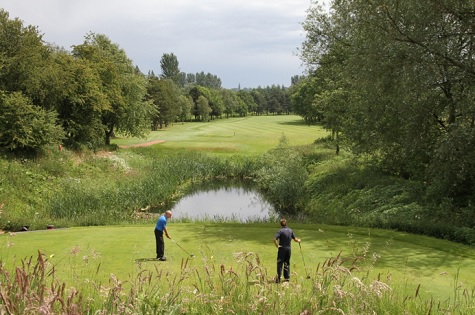
Fiddlers Ferry GC
Many courses have large tree-covered areas that absorb CO₂. Fairways, roughs, and greens capture carbon through photosynthesis. Some courses are on peatland, which can either store or release carbon depending on management.
Coupled with Sustainable Management Practices golf clubs can reduce their inputs of chemical fertilisers, and fuel by changing to electric mowing. Hey can also undertake efficient water use by rainwater harvesting and the use of drought-resistant grasses. Some clubs have fitted solar panels and use electric buggies.
Golf clubs should see the opportunity of bringing in local schools for visits, where children and staff see the work that goes on at the golf course.
In recent years we have seen a number of golf courses embracing Biodiversity Net Gain (BNG), encouraging them to enhance and restore natural habitats while continuing to operate as recreational spaces. From early 2024 BNG is open for developers, land owners, local government to strategically consider projects that will enhance land for good. Golf courses thinking of major developments, such as filling, landscaping, even general fabric enhancements can bring in BNG to assist with a longer-term financial return based on sustainability goals, those goals introduced by the R&A Golf Course 2030 commitment.
Gillyflower Golf Course, Cornwall
Gillyflower Golf Course has adopted eco-friendly practices by replacing traditional chemical fertilisers with seaweed-based alternatives. This natural approach promotes plant growth and stress resistance without harming the environment. Since implementing this policy, the course has observed the return of wildlife, including kingfishers and cormorants, to nearby rivers and the course's lake, Loch McVie.
Ullesthorpe Golf Club, Leicestershire
In May 2023, Ullesthorpe Golf Club hosted a seminar in collaboration with EMEC Ecology to explore BNG funding opportunities. During this event, EMEC demonstrated how the club could enhance grassland, woodland, and pond areas to create a more biodiverse landscape, benefiting both wildlife and golfers.
Celtic Manor Resort Golf Club, Wales
Between 2017 and 2022, Celtic Manor Resort Golf Club reduced its water usage by 42% by constructing a sustainable, closed-loop irrigation system comprising five lakes and a reservoir. This system ensures that the club uses only water from this self-sustaining system, eliminating reliance on mains water. They also monitor usage and leakages, recycle water, and offer reusable water bottles to players.
These examples illustrate how golf courses can effectively implement BNG principles, leading to enhanced biodiversity, improved sustainability, and a positive impact on local wildlife.
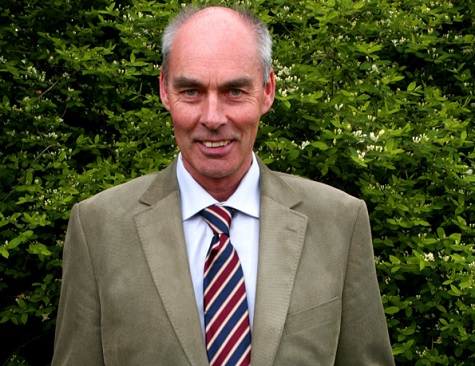
One of the most influential characters, who over many years transformed so many golf courses, was Laurence Pithie who became the first Master Greenkeeper in 1991. He was also honoured as Greenkeeper of the Year in 1984 and Groundsman of the Year in 1988. From 1992 to 2009, Laurence managed multiple golf course sites, initially with a construction company and later with American Golf and Crown Golf.
In 2009 he started his own consultancy business Turf Master One and has written two books, Managing Golf Courses More Effectively and Seasonal Requirements for Golf Course Management. He also authored a comprehensive Golf Course Maintenance Manual produced by the English Golf Union.
I have spent many an enjoyable day with Laurence. He has also penned a number of articles for me over the years. I was particularly impressed with his golf course maintenance manual. It had everything you needed to know about how to manage a golf course.
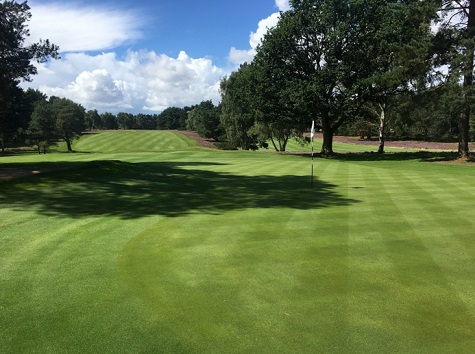
Enville GC
Over the years Laurence helped many greenkeepers to find their potential and go on to managing their own golf clubs.
Andy Wood was one of these. I first met Andy when he was working at Robin Hood Golf Club. In the matter of a few years he had transformed the golf course - improving the golf playing experience to a new level just by modifying a few holes, relocating bunkers and taking maintenance regimes to a new level. After a few years Andy moved to Enville GC where again he has managed to transform the club to be a candidate for a top 100 club status. The work he has achieved with his small team of staff has been exceptional.
The Highgate and Lodge courses are a mixture of picturesque heathland and majestic woodland. In 2025 the Highgate course will be used again by the R&A for Regional Open Qualifying. In 2017 the club proudly hosted the R&A Girls’ British Open Amateur Championship and the R&A Girls’ U16 Amateur Championship from 2021 until 2023.
Andy is now director of golf and oversees the management of the course, essentially wearing two hats. Andy’s working career began after graduating from Myerscough College in 1997 with a HND in Turf Science and Golf Management whilst working at the Belfry, advancing to deputy course manager before the 2002 Ryder Cup.
There are several of Andy’s Belfry work colleagues who have moved on to become course managers in their own right. Luke Dennis, Robin Hood GC; Mark Smith, Oulton GC; and Chris Bromley, Stratford Upon Avon GC.
I have also spent time with Simon White the course manager at The Chase Golf Club in Staffordshire, England. With a career spanning over two decades, Simon has garnered extensive experience in golf course management and greenkeeping that began when he enrolled at Reaseheath College in Nantwich in 1996, where he obtained a Higher National Diploma (HND) in Golf Course Management. During his studies, he completed a work placement at The Forest of Arden Golf & Country Club, gaining valuable experience by participating in a European Tour event.
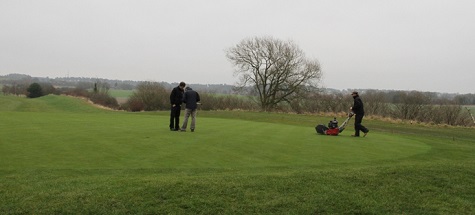
Simon with Mark Allen, Agrovista rep, taking soil samples of the green
Following his time at The Forest of Arden, Simon advanced his career by taking on roles at Abbotsley Golf Hotel and Cotgrave Place Golf Club. In 2007, he joined The Chase Golf Club that he has meticulously maintained, benefiting from its sand and gravel foundation that ensures excellent drainage and year-round playability.
Through his dedication and expertise, Simon White continues to enhance the quality and reputation of The Chase Golf Club, providing an exceptional experience for its members and visitors.
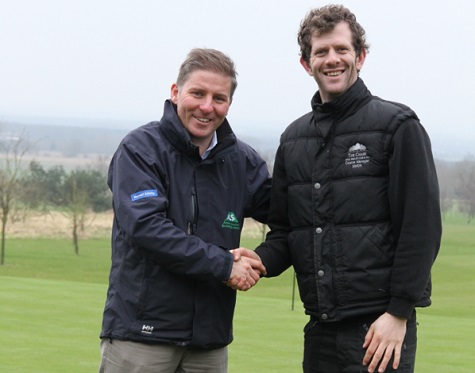
Mark Allen, Agrovista Amenity and Simon White at the Chase GC
Helping all these dedicated greenkeepers are the many company product reps, many of whom are past greenkeepers.
During my visit to the Chase GC Mark Allen was on site taking soil samples. I have known Mark for a few years having worked together at Pitchcare / ALS. Mark, like many of the other reps, has exceptional knowledge of the range of products that have been made to improve plant health and condition soils.
We now have a plethora of products for sale in the form of wetting agents, growth retardants, fertilisers, seed and top dressings. All key ingredients that are available to help promote heathy swards.
These reps are seeing the results of their advice daily, and over time can form strong opinions on what works best for a given sports facility. Over time they tend to build strong relationships with their customers.
Most turf managers are happy to try out new products, if they think it will work in tandem with their own working practices and regimes. And they are fully aware that what works on one golf course may not work at another.
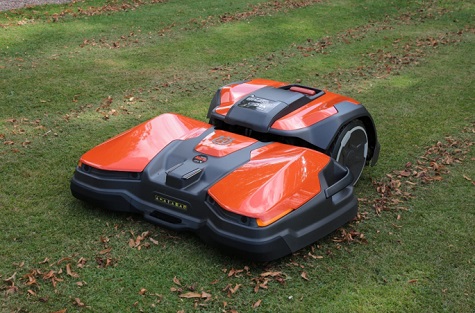
Husqvarna robotic mower
Talking off new products, in recent years we have seen the move towards robotic technologies with a raft of robotic mowers being manufactured primaryly for the domestic and large estate markets. We are now however, seeing a number of golf clubs taking the opportunity of investing in robotic mowers. The development of GPS technologies means these machines can be programmed to cut fairways, semi rough and rough – which is a game changer.
They do not come cheap, but with a cost of a fairway mower now in the region of between £50-100K, the cost of 5 or 6 robots to do the same job, is a close call.
The benefit for golf clubs is it frees up valuable labour to do other jobs. My own worry is if they do become popular and are able to achieve their potential, then we are going to see many more clubs investing in this new way of working - and maybe this could be used as another excuse to reduce staff numbers?
As for other progress seen in the last 50 years, it fundamentally comes down to better education of greenkeepers. And this has come about with the work done by BIGGA since the 1980s, under the stewardship of Neil Thomas, John Pemberton and Jim Croxton.
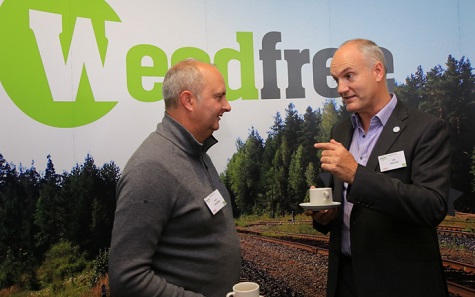
Jim Croxton, right, talking to Paul Woodam, R&A
To help educate and continue to help run the game, the R&A have recently appointed a number of experienced ex greenkeepers to help run their new Sustainable Agronomy Service headed up by Daniel Lightfoot, director - Sustainable Golf at The R&A. And it would seem that from the recent exodus of STRI agronomists to the R&A, that they are certainly looking at providing a new service to support UK greenkeepers in the coming years.
Finally, I believe we need to talk about pay and conditions for greenkeeping.
The pay and working conditions of UK greenkeepers has long been a topic of debate within the golf industry. While greenkeepers play a crucial role in maintaining the quality and playability of golf courses, their compensation and working conditions often do not reflect the skill, dedication, and long hours required for the job.
Current pay for UK greenkeepers
Greenkeeper salaries vary based on experience, qualifications, and location, but many argue that pay is too low given the level of responsibility. According to BIGGA’s 2023 Salary Survey, here are the approximate salary ranges:
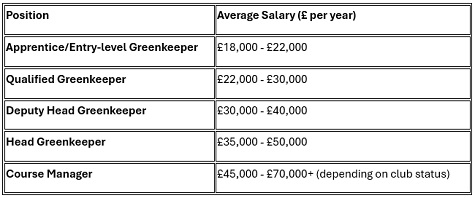
Elite venues (e.g., Open Championship courses, Wentworth, or high-end private clubs) can pay significantly more, but the majority of UK clubs operate at the lower end of these ranges.
Many greenkeepers work long hours, including early mornings, weekends, and adverse weather conditions, without pay that matches their dedication.
While greenkeeping is a rewarding career for those passionate about golf and turf management, working conditions can be challenging:
Are greenkeepers paid fairly?
Many in the industry argue that greenkeepers are underpaid compared to their skill level, responsibilities, and hours worked.
- Jim Croxton (BIGGA CEO) has openly called for better recognition and pay for greenkeepers, stating that their work is essential to golf but undervalued.
- The cost-of-living crisis has made low wages even more of an issue, leading to concerns over greenkeeper retention.
- Many greenkeepers leave the industry for better pay in landscaping, sports turf management, or private estate maintenance.
How can pay & conditions improve?
Better industry-wide pay standards. Clubs need to invest in staff, not just course upgrades. Greater recognition from golf clubs & players – More appreciation of greenkeeping as a profession. Avoid overworking small teams and improve work-life balances.
If clubs want to retain skilled staff, they must invest in better wages, conditions, and appreciation for the role.
Also, for me, one of the biggest problems driving greenkeepers out of the industry is the pressures of work, especially when they are answerable to a greens committee who often do not have any clue or idea of what’s required to maintain a golf course.
Too often it takes time to educate these committees to understand the whole picture, but as soon as you achieve that, another new greens chairman often comes into play and the problem starts all over again. Most course manages spend a lot of time providing reports, educating these committees, conducting walks and explaining specific challenges (e.g., drainage issues, disease management, bunker maintenance).
However, this issue is still a major bone of contention between the course manager and the greens committee. The biggest reason for tension between greenkeepers and committees is lack of understanding and respect for the greenkeeping staff.
Don’t get me wrong there are no doubt many golf clubs who have an excellent working relationship with the greenkeeping staff and all bolds well. However, when it comes to pay and working conditions for many clubs is still way off the mark.
I visit many golf courses where the mess room facilities and sheds are in a disgusting state. I am sure if you were to ask the golf professional or the club secretary to put up with that sort of accommodation, they would soon leave or make a fuss.
These problems tend to be with golf clubs with 5 or fewer staff. In my opinion, there is so much work to be done with a team of 4/5 that they barely get time to sit down, let alone spend hours keeping the mess rooms and shed clean and tidy.
Is it not time that golf clubs realised that a typical 18 hole golf club needs about 7 staff to be efficient and to present the standard of golf they expect. It is time clubs invested more in staff and provided better working conditions.
Running a golf course is a large undertaking and relies heavily on the staff and people working at the club. Without an experienced, motivated workforce the golf course would soon fail to deliver or be profitable and therefore hold it value.
The greenkeeping staff are the key members of any golf facility. It is about time they are given the respect they have earned.
You can also read:
Part one of 50 Years of Golf Stewardship here
Part two of 50 Years of Golf Stewardship here
Part three of 50 Years of Golf Stewardship here
Part one of Cricket Through The Decades here.
Part two of Cricket Through The Decades here
Part one of my 50 years of football here
And part two of 50 years of football here.

