ROBOTIC TIPPING POINT
Turf professionals moving from curiosity to commitment
by Service Dealer Editor, Steve Gibbs
 |
More interesting developments in the arena of robotics for our sector today, with the news that STIGA has announced a new partnership with US-based technology firm SiMa.ai to incorporate its A.I technology into their robotic lawnmower range.
I had to look up what some of the terminology meant in the announcement, but apparently the artificial intelligence they will be using in their units results in an 'ultra low latency' - meaning the mowers can make up their own robot-minds about things super quickly. And that the 'physical A.I' that this partner company specialises in for 'edge' machines, means that the decision-making process is all contained within the equipment itself - not relying on speaking to clouds or whatnot. So top-level, advanced stuff by the sounds of things - which will clearly be important for STIGA now that they are competing in the professional market as well their traditional domestic sphere.
This high-degree of sophistication is of course common across many of the different robotic brands that our dealer readers specialise in - especially those used in a commercial setting. It wasn't long ago that the machines required a wire to be buried in the ground around the perimeter of the grassed area to be mown. Dealers tell me that those became pretty much obsolete overnight due to the speed of development seen in the sector.
That pace of advancement from the manufacturers feels like it is now being matched in the acceptance and take-up of the technology by end-users - both domestic and especially professional. We've been hearing that for a while now in conversations we've had with our dealer readers who advocate robotics - and it was brought into sharp focus this week at the ScotsTurf show that took place at Hamiliton Park.
Great friend of Service Dealer and owner of Strathbogie Forest & Garden, Pete McArthur, was exhibiting at the event that was in its second edition, and remarked on just how apparent a switch in attitude to automation there had been in the past year.
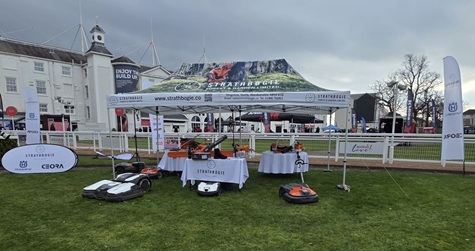
Writing on LinkedIn, Pete said, "In just one year of attendance, the show has transformed from a traditional turf care event into a full blown technology and robotics showcase. The shift wasn’t subtle - it was unmistakable." Pete described how only a year ago many of the professional end-user visitors to the show were perhaps curious about the use of robotics on their surfaces, but were not quite ready to make the transition.
But Pete says there was a clear change this year. He explained, "Personally after 20+ years in robotic mowing, I knew the tipping point would arrive. Innovation always feels uncomfortable right before it becomes obvious." The conversations were different, he said. Pete felt the questions were sharper and the appetite for automation was real.
Pete went on to observe that the professional teams that he encountered at ScotsTurf this week were actively looking for, "Smarter, leaner operations. Cost effective solutions. Better results with the same (or fewer) resources. And ways to free skilled staff for higher value work."
This comment regarding staffing, is one of the absolute key drivers in the progression of robotics in commercial applications. Yes, the machines themselves are undoubtedly becoming even better at their jobs and in their user-friendly functionality - but alongside this there is a genuine need for them as clubs and facilities are struggling to recruit team members.
It's a subject that editor of our sister title, TurfPro, Laurence Gale has addressed many times. Across the UK and much of Europe, recruiting and retaining skilled turf professionals has become increasingly challenging. Turf managers are under pressure to maintain and improve standards while operating with tighter budgets and teams. Robotic mowing does not replace people, but it does change how their time is used.
Instead of spending hours sat on a mower completing routine cutting tasks, staff can focus on higher-value work such as presentation, repairs, aeration, irrigation management and all the other detailed tasks that often get pushed down the priority list when resources are stretched.
This shift in working practices has been clearly observed by progressive dealers around the country such as Pete, and represents fresh opportunities to be the local, go-to expert in the technology. It requires a different, modified approach to sales and service, but for many dealerships it will be their future - one in fact, that has already arrived.
|
|