We feature a fascinating story today regarding a recent report from Aviva that has revealed that British consumers are embracing smart technology in ever-greater numbers - with robotic mowing solutions said to be among the fastest-growing sectors.
The news states that last year alone, over £300 million was spent in the UK on robot lawn mowers. We know from speaking to you, our valued dealer readers this year, and from the responses you've given to our surveys, that our android friends are now seeing excellent growth not just amongst homeowners, but increasingly in the professional sector too.
Segway, makers of the Navimow range, have certainly noted the shift in buyers' attitudes and have used the Aviva report to show off their own figures. The company says global revenue for its robotic mowers rose by 380% in the first three quarters of 2024 compared to the previous year - and points to advancing GPS integration, improved smart home compatibility and better battery life as key factors in the category’s popularity in the domestic sphere.
Certainly the GPS integration is a factor that many dealers have remarked to us this year as being a huge contributory factor to the uptick in sales. Several have told us this development has almost made the boundary-wire models obsolete overnight.
What is clear is that robotic mowing is no longer a niche solution for tech-loving, early adopting, enthusiasts. These machines are quickly becoming mainstream, with broad appeal that spans domestic gardens, estates, local authorities and, especially, golf courses. Several dealers we have spoken to recently, are pointing to the technology as a real bright point in what might be described as a challenging season.
Husqvarna's renaissance
To get a clearer view of how the UK industry is responding, Service Dealer's owner Duncan Murray-Clarke, along with our operations coordinator, Nikki Harrison, visited the Husqvarna factory and HQ at Newton Aycliffe last week - a key production site for robotic mowers worldwide.
They met several members of the senior management team, including Stewart Carter, Jonathan Snowball, Karl Hansell, Paul Coates, Phil Holdsworth and Steven Irvine. Duncan said the visit offered an eye-opening look at a company with a long history in robotics. 2025, in fact, marks 30 years since the launch of their Automower. Today the company is continuing to invest heavily to maintain its position in the market.
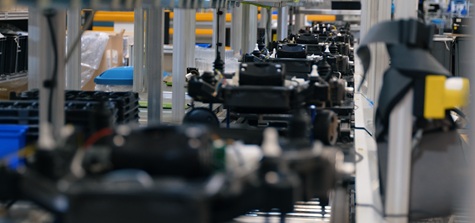
Much of Husqvarna’s global robotic mower range is now manufactured and assembled at Newton Aycliffe, with many key components, including batteries, also made on-site. The Service Dealer team said it was impressive to see a strong British manufacturing story backed up by automation, but also a flexible and significant local workforce, ranging from 230 employees up to 880 at peak times.
Like many in the industry, Husqvarna was not immune to the challenges of the post-Covid period - including supply chain disruption and staffing pressures. However, the management team was candid to Duncan and Nikki about these issues, saying they have responded with a renewed focus on resilience and logistics. Considerable investment has gone into both the team and facilities, and the impact on dealer service levels appears to be positive.
Phil Holdsworth, head of sales operations, shared that dealer response time targets are now being met 89% of the time whilst back order waiting time is reduced by 50%, backed up by a team which has doubled in size recently. An area of ongoing focus.
Sales-wise, we were told that 2025 has started solidly for the company. Residential robotics are up 5%, handheld battery tools have surged by 31%, and even petrol product sales are up 5%. Meanwhile, ride-on mower sales are down 5% - a shift that clearly mirrors the rise in robotic alternatives. Their professional robotics are up 69% and the dealer network now numbers 186 store locations, with 81 of those certified Ceora specialists.
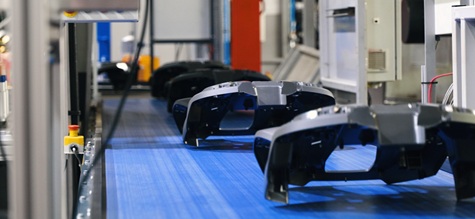
Last year was a record-breaker for Husqvarna UK, with turnover reaching SEK 800 million. That confidence was reflected in the mood of the Newton Aycliffe team, with Duncan describing them as upbeat, focused, and keenly aware of the brand’s opportunities, particularly in commercial sectors.
Perhaps most symbolic of how far things have come, we were told that we are about to see the first ever Women’s Open tournament played on a course where robotic mowers maintain the fairways - an achievement approved by the The R&A and a world first.
“The AIG Women's Open is a very exciting project we are proud to be involved with," Jonathan Snowball, head of Professional UK told us. "Royal Porthcawl Golf Club have really embraced the technology and the results are amazing."
Duncan summed up the visit saying, "It is clear that there has been an overhaul at Husqvarna UK and the results seem to be reflecting that. The team looked confident and upbeat. Now in their 30th year of the Automower, they pioneered the robotic mowing scene and arguably have stayed ahead of the competition. With one third of Europe’s golf courses in the UK using robotics, their focus now is very much on the opportunity that the Ceora offers in the golf and sporting world."
It seems to me that many industry experts believe that robotic mowing is poised to become the dominant force in professional turf care. Husqvarna clearly believes that they and their dealers are well placed to benefit from what is shaping up to be a significant, sustained shift in the market.
Of course other manufacturers also offer professional robotic mowing solutions and will be keen to make sure that their offerings are competitive, giving turf professionals - and dealers - real choice. And for those manufacturers currently without a commercial robotic mower on the market, surely they must be working at double-speed behind the scenes to get one out into dealerships?