Data on farm accidents were collected through the Teagasc National Farm Survey (NFS) in 2017, involving recall of accidents over the previous five year period. As well as reporting the overall level of accidents, the aim of the survey was to further ascertain the causes or contributory factors associated with accidents and to identify those most at risk with a view to assisting with future policy and safety promotion. Data on the prevalence of farm accidents (and specific type) by farm system and age were reported in addition to information on the category of persons injured, medical treatment required and the length of work absence as a result.
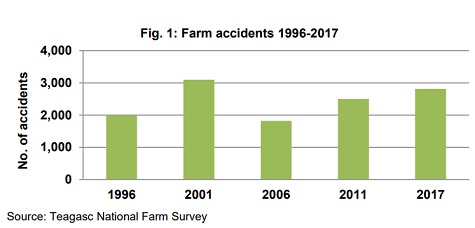
According to the Teagasc Survey 11% of respondents experienced an accident causing injury on their farm over this period. There were 2,814 farm accidents in 2017, a 13% increase on the 2011 figure. Figure 1 illustrates the steady rise in farm accidents since 2006 in particular, and reflects a 41% increase in 2017 farm accidents compared to the previous 20 years.
Over this period the data indicates that 42% of accidents involved livestock with farm vehicles or machinery cited in a further 25% of cases.
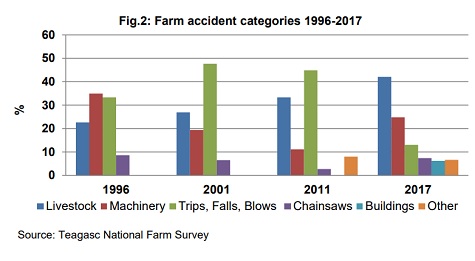
Trips or falls resulted in a further 13% of farm accidents over the period with chainsaws accounting for 7% and a further 6% involving farm buildings. The increasing proportion of accidents involving livestock over time is evident with a 20% increase from 1996 to 2017. Accidents involving machinery more than doubled from 2011 to 2017.
Person Injured & Location and Medical Treatment Required
The vast majority of on-farm accidents (92%) involved family members. Indeeed 80% of the accidents involved the farmer with 12% involving the spouse or other family member. The remaining accidents involved workers (5%) and others (3%).
Almost two-thirds of farm accidents occurred in the farmyard (64%) and a further 15% in farm buildings. Almost one-fifth of accidents (19%) were in fields with only 2% on farm roadways or lanes.
Almost all of the reported farm accidents (97%) required medical treatment with 73% of victims attending hospital, a further 19% a doctor and 4% requiring first aid. Tragically 1% of such accidents resulted in a fatality.
Recovery time
In terms of the impact of such accidents, almost one-third (30%) resulted in the victim being out of work for more than a month with 21% reporting an absence of more than two months. On the other hand, almost one-fifth (17%) reported that the accident did not result in them taking time off (perhaps out of necessity?). 18% reported a work absence of 1-3 days with 22% reporting a recovery period of 4-10 days. 13% of those involved in farm accidents were out of work for 11 to 30 days.
Accident occurrence by farm system
Accidents are most prevalent on dairy farms with 18% of them reporting an accident over the five year period. However cattle systems reported a figure close to this (17%). Accidents occurred on 12% of tillage farms with the figure marginally lower on sheep farms at 11%.
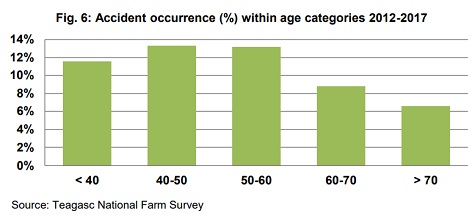
The 2017 data indicates that younger farmers are more likely to have farm accidents, whereas data from the Health and Safety Authority (HSA) indicates that fatal accidents are more likely among older farmers. The 2017 data indicates that only 7% of farmers aged over 70 were involved in an accident over the period. Similarly, only 9% of farmers aged 60-70 were reportedly involved in an accident over the time frame. The younger age categories were more accident prone with 13% of farmers in the 40-50 and 50-60 age brackets involved in an accident and 12% of those aged below 40.
Accidents involving livestock was the most common cause across all age categories except where the victim was aged over 70 in which case they were more likely to involve farm buildings. Livestock related accidents accounted for over half (51%) of all accidents involving those aged 50-60 and almost half of those (46%) in the less than 40 age category. Accidents involving livestock were also common in the 40-50 and 60-70 age categories accounting for 37% and 38% of all accidents re.
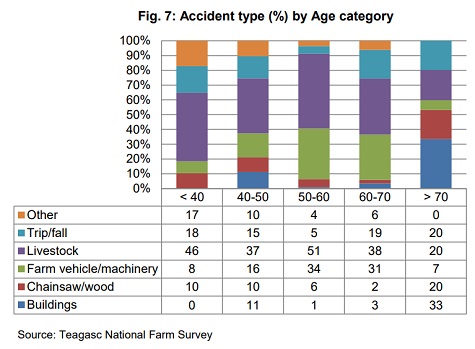
Accidents involving farm vehicle and machinery were most common for those farmers aged between 50 and 70 years.
Conclusion
Results from the Teagasc survey indicated that on farm accidents causing injury occurred on 11% of farms in 2017, a 13% increase compared to 2011 when the last survey was undertaken. Accidents were highest on dairy and cattle farms while 42% of all accidents involved livestock. Farm vehicles or machinery accounted for a further 25% of accidents. The vast majority of farm accidents (92%) in 2017 involved family member with 80% of accidents occurring in the farmyard or in farm buildings. Surprisingly, farmers aged over 60 were less likely to have an accident with higher proportions in the middle aged categories involved in accidents over the period .